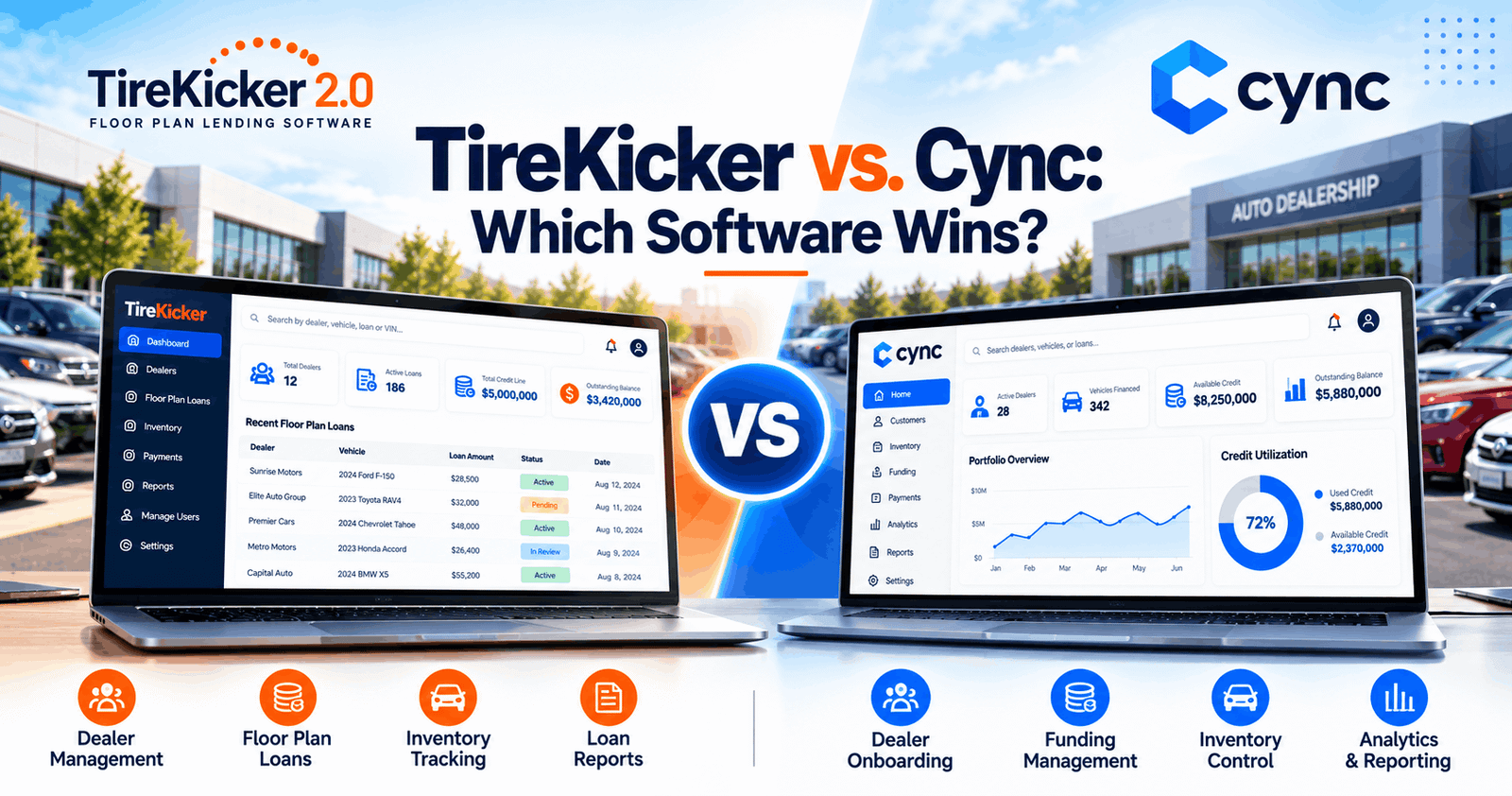
Choosing the right floor plan lending software can make a meaningful difference in how lenders manage auto dealer relationships, track financed inventory, monitor collateral, and oversee loan activity. For businesses specializing in floor plan lending, the best software should support the operational details of dealer financing rather than simply provide general loan management capabilities.
TireKicker 2.0 and Cync Software serve lending businesses, but their primary areas of focus differ. TireKicker 2.0 is purpose-built for floor plan lenders managing dealer accounts, advances, vehicle inventory, audits, billing, and collateral records. Cync Software offers solutions for broader commercial lending activities, including asset-based lending and invoice factoring.
For lenders comparing these lending software, the key question is which solution aligns most closely with their portfolio, dealers, collateral requirements, and day-to-day lending workflows. This comparison examines their positioning, relevant capabilities, and potential fit for floor plan lending operations.
What Is TireKicker 2.0?
TireKicker 2.0 is a cloud-based lending management software developed for floor plan lenders and other businesses that finance assets individually. Built on more than 25 years of floor plan lending experience, it brings essential lending operations together in a centralized system.
Unlike generic loan management tools, TireKicker 2.0 lending software is designed around the workflows involved in financing dealer inventory. Lenders can organize dealer accounts, track advances and balances, monitor financed vehicles, manage billing, and maintain records that support audits and collateral oversight.
Key capabilities of TireKicker 2.0 Lending Software include:
- Dealer and advance management: Organize dealer accounts, credit lines, advances, balances, curtailments, and related loan activity.
- Vehicle inventory tracking: Maintain inventory records by dealer and vehicle identification number (VIN) to improve visibility into financed assets.
- Billing and payment management: Organize invoices, fees, payoffs, curtailments, and payment histories.
- Audit and compliance workflows: Schedule inventory audits, record findings, flag discrepancies, and maintain audit histories.
- Title and collateral management: Track title locations, outstanding documents, and collateral-related records.
- Dealer portal and funding requests: Give authorized dealers access to relevant loan information, audit summaries, communications, and funding request workflows.
- Reporting and analytics: Review portfolio activity by dealer, asset type, or operating zone.
These capabilities help floor plan lenders organize their operations and improve visibility into dealer financing activity. Instead of relying on disconnected spreadsheets and records, teams can work with more structured information across key lending processes.
For lenders looking for floor plan management software, TireKicker 2.0 offers a focused approach to managing advances, dealer inventory, billing, audits, and collateral information.
What Is Cync Software?
Cync Software provides technology for commercial lenders and specialty finance businesses. Its product offerings address areas such as asset-based lending (ABL), invoice factoring, collateral management, loan monitoring, and related commercial lending workflows.
Asset-based lenders often need to evaluate eligible collateral, manage borrowing bases, monitor credit limits, and track advances and reserves. Factoring businesses also need to manage accounts receivable and associated financing activity. Cync’s solutions are designed to support these types of lending operations.
Relevant capabilities described in Cync’s product materials include:
- Collateral and loan monitoring: Organize collateral information and monitor lending activity.
- Advance and reserve management: Support lending calculations and processes associated with eligible collateral.
- Borrowing base workflows: Help manage borrowing base information and related certificates.
- Invoice factoring: Support financing processes involving accounts receivable.
- Commercial lending support: Address workflows used by asset-based lenders and specialty finance providers.
These capabilities can be relevant to financial institutions managing different types of commercial credit and collateral. However, the specific functions available depend on the Cync product and configuration being evaluated.
For floor plan lenders, the important consideration is how well a lending software supports the details of dealer inventory financing. General collateral management and commercial lending functions may address some overlapping needs, but lenders should verify the availability and suitability of specific vehicle-level, dealer, audit, title, and payment workflows before making a decision.
TireKicker vs. Cync Software: Key Differences
Although both lending software serve lending businesses, their primary positioning gives lenders a useful starting point for comparison. TireKicker 2.0 focuses on floor plan lending operations, while Cync software addresses broader asset-based lending and factoring needs.
| Comparison Area | TireKicker 2.0 | Cync Software |
|---|---|---|
| Primary Focus | Purpose-built floor plan lending workflows | Broader asset-based lending, factoring, and commercial lending |
| Target Users | Floor plan lenders managing dealer-financed inventory | Commercial lenders, asset-based lenders, and factoring businesses |
| Dealer and Loan Management | Supports dealer accounts, advances, balances, and related lending activity | Evaluate the relevant product’s support for the specific dealer lending workflow |
| Vehicle Inventory Tracking | Supports inventory records organized by dealer and VIN | Confirm vehicle-level tracking and floor plan-specific functionality for the selected product |
| Billing and Payments | Supports invoices, fees, payoffs, curtailments, payment histories, and related payment workflows | Confirm the required payment and billing workflows for the product being considered |
| Audits and Collateral | Includes audit scheduling, results, variance tracking, title tracking, and collateral records | Assess how the selected product handles physical inventory verification, titles, and collateral monitoring |
| Dealer Collaboration | Includes a dealer portal and funding request workflows | Confirm whether available dealer-facing functions meet the lender’s requirements |
| Reporting | Supports reporting by dealer, asset type, and zone | Assess available reporting and analytics against the lender’s portfolio needs |
TireKicker capabilities are based on its published features. Cync’s positioning reflects its published focus on asset-based lending and factoring. Product-specific capabilities that are not established by the available documentation should be verified rather than assumed to be unavailable.
1. Purpose-Built Floor Plan Lending vs. Broader Commercial Lending
One of the most important differences is the lending context each software platform is designed to serve.
Floor plan lenders finance inventory held by dealers and must maintain visibility into the relationship between each dealer, its credit facility, outstanding advances, and financed vehicles. Their operational needs can include inventory audits, title follow-up, curtailments, payoff processing, and ongoing monitoring of collateral.
TireKicker 2.0 is built around these floor plan lending activities. This makes it a strong option for lenders seeking a specialized system for organizing dealer financing workflows.
Cync’s broader asset-based lending and factoring focus may suit lenders working with accounts receivable, borrowing bases, reserves, and other forms of commercial collateral. A lender considering Cync for floor plan financing should establish whether its selected product can support the required dealer and vehicle-level processes.
For businesses whose primary activity is financing dealership inventory, a purpose-built platform can be a more direct fit than adapting a broader lending system to specialized workflows.
2. Dealer Accounts and Vehicle Inventory Management
Managing dealer relationships involves more than maintaining a list of borrowers. Floor plan lenders need to connect dealer accounts with credit lines, advances, financed vehicles, outstanding balances, and supporting collateral records.
TireKicker 2.0 lending software supports dealer account management and inventory tracking by VIN. This helps lending teams review financed assets associated with each dealer and organize information needed for ongoing portfolio oversight.
Its relevance is especially clear when lenders need to manage dealer inventory and maintain organized records of the vehicles securing outstanding financing.
Cync supports collateral management in its broader lending context. However, lenders should verify how the specific Cync product handles VIN-level vehicle records, dealer-level inventory visibility, and the relationship between individual assets and floor plan advances.
For lenders managing multiple dealerships, the right solution should make it straightforward to locate vehicle records, review dealer exposure, and identify discrepancies that require attention. TireKicker’s published focus on these floor plan workflows makes it a particularly relevant lending software to evaluate.
3. Auto Advances, Billing, and Portfolio Visibility
Efficient floor plan lending depends on keeping loan balances, advances, curtailments, payments, and dealer activity organized. When these records are spread across separate systems, lending teams may spend additional time reconciling information and investigating discrepancies.
TireKicker 2.0 brings key lending activities into a centralized workflow. Lenders can track advances and balances, organize invoices and payment histories, monitor curtailments, and review relevant dealer and vehicle records. These capabilities support more consistent oversight of outstanding financing and day-to-day lending operations.
For lenders seeking to improve auto advances management, having access to organized loan and dealer information can make it easier to review account activity and follow up on outstanding items.
Cync also supports lending and collateral-related workflows in its target markets. However, floor plan lenders should compare the exact advance, payoff, curtailment, and dealer billing processes available in the Cync software product they are considering.
The right floor plan lending software should align with the lender’s existing repayment processes and provide useful visibility into portfolio activity. For lenders whose core business is dealer inventory financing, TireKicker’s floor plan-specific approach makes it a strong contender.
4. Inventory Audits, Titles, and Collateral Oversight
Inventory verification and collateral oversight are essential parts of managing floor plan loans. Lenders need processes for confirming that financed vehicles can be accounted for, identifying inventory discrepancies, and following up on outstanding titles or supporting documents.
The scale of dealer inventory financing illustrates why these activities matter. According to a 2025 Ford Credit floor plan securitization disclosure filed with the U.S. Securities and Exchange Commission, Ford Credit financed approximately 70%–74% of new-vehicle inventory at Ford and Lincoln dealerships in the United States over the preceding five years. The disclosure also describes inventory audits and ongoing collateral monitoring as elements of its risk management practices.
This figure applies specifically to Ford and Lincoln dealerships, not the entire automotive lending industry. Nevertheless, it illustrates the importance of maintaining accurate records and monitoring financed inventory.
TireKicker 2.0 lending software includes tools for scheduling audits, assigning audit activity, recording results, flagging variances, and maintaining audit histories. Its title and collateral management capabilities also help lenders track title locations and identify outstanding documentation.
Cync’s collateral management capabilities are relevant to lenders working with asset-backed financing. However, floor plan lenders should verify the availability of the specific vehicle-level audit, title tracking, and dealer inventory workflows they require.
For floor plan enders prioritizing dealership inventory verification and collateral oversight, TireKicker’s specialized capabilities make it a compelling option to evaluate.
TireKicker 2.0 and Cync Software: Which Software Is Better for Floor Plan Lenders?
The best lending software depends on the type of financing a business provides, the assets it monitors, and the workflows its team needs to manage every day. TireKicker 2.0 and Cync Software address overlapping areas of lending operations, but their primary focus differs.
TireKicker 2.0 is a strong choice for lenders whose core business is floor plan financing. Its published capabilities are built around dealer accounts, advances, VIN-level inventory tracking, billing, audits, title management, and dealer collaboration. These functions align directly with the daily responsibilities of lenders financing automotive inventory.
Cync Software may be relevant for financial institutions with broader asset-based lending or factoring requirements. Its focus on collateral monitoring, borrowing base processes, and commercial lending can make it suitable for those operating models. Lenders considering it for floor plan financing should confirm that its available products meet their dealer-specific requirements.
Consider the following decision points before choosing between TireKicker 2.0 and Cync Software:
- Choose TireKicker 2.0 for evaluation if your priority is specialized floor plan lending, dealer account management, financed vehicle tracking, inventory audits, title follow-up, and advance administration.
- Evaluate Cync Software if your lending operation centers on broader asset-based lending, invoice factoring, or commercial credit workflows and its product capabilities align with your requirements.
- Compare both software directly if your business combines floor plan financing with other forms of asset-based lending. Validate specific workflows, integrations, implementation requirements, reporting, and pricing before making a final decision.
For floorplan lenders looking for the best fit for dealer inventory financing, the priority should be a lending software that supports the full floor plan lending lifecycle. TireKicker 2.0 deserves a place at the top of that shortlist because its published feature set is specifically oriented toward floor plan lending operations.
Why Consider TireKicker 2.0 for Floor Plan Lending Instead of Cync Software?
Floor plan lenders have specialized operational needs. Managing dealer credit lines, financed vehicles, advances, inventory audits, payments, and collateral records requires more than general-purpose loan tracking. The software should reflect the way floor plan lending actually works.
TireKicker 2.0 is designed to address these needs in a single lending software solution. Here are the main reasons floor plan lenders should consider it.
Purpose-Built for Floor Plan Lending
TireKicker 2.0 is designed around the workflows of floor plan lenders rather than positioning itself primarily as a broad commercial lending or factoring system. Its focus on dealer financing, advances, vehicle inventory, and collateral oversight makes it particularly relevant to businesses financing dealership inventory.
For lenders seeking specialized floor plan finance software, this focus provides a practical starting point for evaluating operational fit.
Better Visibility Into Dealer Inventory and Advances
TireKicker 2.0 connects dealer and advance management with vehicle inventory records, helping lending teams review outstanding financing and associated assets. VIN-level tracking supports the identification of individual vehicles, while organized loan records help teams review balances and financing activity.
These capabilities can be valuable for lenders managing multiple dealer relationships and seeking clearer visibility into their portfolios.
Organized Audits and Collateral Records
Inventory audits, title tracking, and collateral documentation are important to floor plan lending risk management. TireKicker 2.0 provides workflows for scheduling audits, recording findings, identifying discrepancies, and monitoring outstanding titles.
By bringing these activities into a structured platform, lenders can improve access to relevant information and organize follow-up across dealer accounts and financed assets.
Streamlined Dealer and Lending Workflows
Dealer communication, funding requests, billing, and repayment tracking are recurring parts of floor plan lending. TireKicker 2.0 includes a dealer portal and tools for managing funding requests, invoices, curtailments, payoffs, and payment histories.
This gives lenders a centralized way to organize important interactions and lending records instead of depending entirely on disconnected tools and manual processes.
Built Around Practical Floor Plan Lending Experience
TireKicker draws on more than 25 years of floor plan lending experience. That background informs its focus on the operational details of dealer financing and the requirements of lenders managing inventory-backed credit.
For businesses evaluating the latest generation of lending technology, TireKicker 2.0 combines this industry-specific focus with a cloud-based platform, reporting capabilities, and support for structured data migration.
Cync Software remains worth evaluating for lenders whose requirements extend across broader asset-based lending and factoring. However, when the priority is managing dealer financing and vehicle inventory through specialized floor plan workflows, TireKicker 2.0 offers a strong, relevant alternative to consider.
Floor plan lenders can explore the software’s dealer management software for lenders capabilities to understand how its workflows align with their operations.
Conclusion
Comparing TireKicker vs. Cync Software comes down to the lending model, operational requirements, and type of collateral being managed. Cync serves broader commercial lending, asset-based lending, and factoring needs, while TireKicker 2.0 focuses on the workflows associated with floor plan financing and dealer inventory.
For floor plan lenders, TireKicker 2.0 stands out as a specialized option for organizing dealer accounts, advances, vehicle inventory, billing, audits, title tracking, and collateral oversight. Its purpose-built approach makes it a strong software to consider for lenders seeking more structured floor plan lending operations.
If your priority is finding the best software fit for managing dealer financing, start by reviewing your current workflows and identifying where inventory visibility, advance tracking, audits, or dealer communication need improvement. You can also compare best auto loan management software options to understand the broader market.
Explore TireKicker pricing and subscription plans or request a demonstration to see how TireKicker 2.0 can support your floor plan lending operations.


