The auto lending industry is evolving rapidly. As loan portfolios grow, regulatory requirements become more demanding, and borrower expectations shift toward digital experiences, lenders can no longer rely on spreadsheets, disconnected systems, or manual workflows to manage their operations effectively.
Whether you’re a bank, credit union, independent finance company, or floor plan lender, managing thousands of loans, dealer relationships, collateral, payments, compliance, and reporting requires far more than a basic loan tracking system. Modern auto loan management software helps lenders automate repetitive tasks, improve operational efficiency, reduce risk, and deliver a better experience for both internal teams and dealership partners.
Today’s leading platforms do much more than record loan information. They centralise the entire lending lifecycle—from dealer onboarding and loan origination to payment tracking, inventory management, title administration, audit management, reporting, and borrower communications for car lender. By replacing fragmented processes with a unified platform, lenders gain greater visibility into portfolio performance while improving compliance and decision-making.
However, not all software solutions are built for the same type of lending operation.
Some platforms are designed for consumer auto lending, while others specialise in dealer floor plan financing, inventory-backed lending, commercial finance, or enterprise loan servicing. Choosing the right solution depends on your business model, portfolio size, operational complexity, compliance requirements, and future growth plans.
In this guide, we’ve evaluated the best auto loan management software available in 2026, comparing each platform based on functionality, scalability, ease of use, security, reporting capabilities, and overall value. We’ll also highlight which solutions are best suited for specific lending organisations, from community lenders to enterprise financial institutions.
What Is Auto Loan Management Software?
Auto loan management software is a specialised platform that enables lenders to manage every stage of an automotive loan’s lifecycle through a single, integrated system. It combines loan servicing, payment processing, collateral management, reporting, compliance, and customer relationship management into one centralised solution.
Instead of relying on multiple disconnected applications, lenders can oversee their entire portfolio from a single dashboard while automating routine administrative tasks that traditionally consume significant staff time.
For organizations financing dealerships through floor plan lending, these platforms often include additional capabilities such as inventory tracking, title management, audit scheduling, dealer portals, and collateral monitoring.
At its core, auto loan management software provides greater visibility, operational control, and scalability while helping lenders minimize risk and improve borrower and dealer experiences.
How Auto Loan Management Software Works
Although each platform offers different capabilities, most follow a similar operational workflow.
Dealer or Borrower Onboarding
The lending process begins by collecting customer or dealership information, verifying documentation, and creating secure user accounts. Many modern platforms automate identity verification, document collection, approval workflows, and role-based permissions to streamline onboarding while maintaining compliance.
Loan Origination and Approval
Lenders create financing agreements by defining loan amounts, interest rates, repayment schedules, collateral requirements, and approval conditions. Automated workflows reduce manual data entry and help standardise underwriting decisions across the organisation.
Loan Servicing
Once funding is complete, the software manages the day-to-day servicing of each loan, including:
- Payment schedules
- Interest calculations
- Outstanding balances
- Payment history
- Late fees
- Delinquency tracking
- Payoff quotes
- Early settlements
- Loan modifications
Automation helps reduce servicing errors while providing borrowers and dealers with accurate, real-time account information.
Collateral and Inventory Management
For dealer financing and floor plan lending, collateral management is just as important as loan servicing.
Modern platforms allow lenders to:
- Track financed vehicles by VIN
- Monitor inventory across multiple dealerships
- Record title status
- Flag missing collateral
- Schedule inventory audits
- Monitor ageing inventory
- Maintain complete collateral histories
These capabilities help lenders reduce portfolio risk while ensuring financed assets remain properly accounted for.
Payment Collection and Monitoring
Loan management software automates recurring payment schedules, payment reminders, transaction recording, reconciliation, and overdue account monitoring.
Many platforms also integrate with ACH payment systems, allowing lenders to streamline collections while reducing administrative overhead.
Reporting and Portfolio Analytics
Executives and portfolio managers need more than raw data—they need actionable insights.
Most modern platforms provide dashboards showing:
- Active loan balances
- Portfolio growth
- Delinquency trends
- Dealer performance
- Collection rates
- Payment history
- Audit findings
- Financial performance
- Compliance reporting
Real-time reporting enables organizations to identify issues earlier and make data-driven lending decisions.
Compliance and Audit Management
The lending industry operates within a highly regulated environment. Auto loan management software helps organisations maintain compliance through features such as:
- Audit trails
- User activity logging
- Role-based access controls
- Secure document storage
- Automated notifications
- Compliance reporting
- Document retention
- Security monitoring
These tools simplify internal governance while supporting regulatory readiness.
Why Auto Lenders Need Loan Management Software
Managing automotive loans has become significantly more complex over the past decade. Increased regulatory scrutiny, larger dealer networks, growing customer expectations, and rising portfolio sizes have made manual processes both inefficient and risky.
Modern auto loan management software helps lenders replace disconnected systems with a single source of truth, improving efficiency across every department.
Eliminate Manual Processes
Many lenders still rely on spreadsheets, email chains, paper files, and multiple software applications to manage their operations.
This often results in:
- Duplicate data entry
- Human errors
- Delayed approvals
- Lost documentation
- Inconsistent reporting
- Limited operational visibility
A unified loan management platform automates repetitive tasks and ensures information remains accurate across the organization.
Improve Payment Tracking
Missed payments directly affect cash flow and increase collection costs.
Modern software automatically tracks repayment schedules, calculates balances, generates reminders, records transactions, and flags overdue accounts before they become larger collection issues.
This allows finance teams to spend less time chasing payments and more time managing portfolio performance.
Strengthen Dealer Relationships
For organisations financing dealerships, maintaining strong dealer relationships is essential.
Dealer portals provide a secure environment where dealerships can:
- View active financing
- Monitor outstanding balances
- Access payment schedules
- Upload required documents
- Track inventory
- Request adjustments
- Communicate directly with lenders
Self-service capabilities reduce administrative workloads while improving the dealer experience.
Increase Visibility into Financed Inventory
Floor plan lenders face unique operational challenges because financed vehicles serve as collateral.
Without accurate inventory visibility, lenders may struggle to identify missing vehicles, delayed title releases, ageing inventory, or audit discrepancies.
Purpose-built software enables lenders to monitor financed assets in real time, supporting better risk management and operational oversight.
Simplify Compliance
Financial institutions must maintain detailed records while demonstrating compliance with internal policies and external regulations.
Loan management software supports these requirements through comprehensive audit trails, user permissions, activity logging, document management, and configurable workflows that reduce compliance risk.
Make Better Lending Decisions
Data-driven lending is becoming a competitive advantage.
Advanced dashboards and reporting tools allow decision-makers to analyse dealer performance, repayment trends, portfolio growth, delinquency rates, collateral quality, and operational efficiency from a single platform.
These insights support faster, more informed lending decisions and help organisations identify opportunities for growth.
How We Evaluated the Best Auto Loan Management Software
Choosing an auto loan management platform is a long-term investment. Beyond managing loans, the right software should improve operational efficiency, strengthen compliance, simplify dealer relationships, and scale alongside your business.
To create this comparison, we evaluated each platform against the features and capabilities that matter most to lenders, auto finance companies, banks, credit unions, and floor plan finance providers.
Rather than focusing solely on popularity, we considered how well each solution supports the complete lending lifecycle—from loan origination and servicing to collateral management, reporting, and compliance.
Loan Management Capabilities
A strong auto loan management platform should simplify every stage of the lending lifecycle.
We assessed each solution based on its ability to:
- Create and manage loans
- Configure flexible repayment schedules
- Calculate interest and outstanding balances
- Process early payoffs and settlements
- Track loan status from origination to closure
- Support refinancing or loan modifications
- Manage delinquent accounts
Platforms that automated routine servicing tasks scored significantly higher than those requiring manual intervention.
Dealer and Customer Management
Dealer relationships are central to automotive lending, particularly for floor plan finance companies.
We evaluated whether each platform supports:
- Dealer onboarding
- Secure dealer portals
- Customer profile management
- Dealer performance tracking
- Communication history
- Credit limit management
- Multi-user account administration
Software that encourages collaboration between lenders and dealerships generally reduces administrative overhead while improving customer satisfaction.
Inventory and Collateral Management
Inventory-backed lending requires much more than standard loan servicing.
We gave additional weight to platforms capable of managing:
- Vehicle inventory
- VIN tracking
- Title management
- Collateral monitoring
- Missing inventory alerts
- Inventory ageing
- Floor plan financing
- Audit preparation
These capabilities are especially important for lenders financing dealerships and commercial vehicle inventories.
Payment Processing and Collections
Effective payment management directly impacts portfolio performance and cash flow.
Each solution was assessed for its ability to:
- Automate repayment schedules
- Process recurring payments
- Generate payment reminders
- Record payment history
- Track overdue accounts
- Calculate penalties
- Support ACH or electronic payments
- Generate payoff quotes
Automation helps reduce collection costs while improving repayment consistency.
Reporting and Analytic
Modern lending decisions rely on accurate, real-time information.
We reviewed the reporting capabilities of each platform, including:
- Portfolio dashboards
- Loan performance reports
- Dealer performance analytics
- Delinquency reporting
- Financial summaries
- Inventory reports
- Audit reporting
- Custom report generation
- Data export options
Solutions providing configurable dashboards and visual analytics received higher rankings.
Compliance and Security
Financial software must protect sensitive borrower and dealer information while supporting regulatory compliance.
Our evaluation considered:
- Role-based access control
- Multi-factor authentication
- Audit trails
- User activity logging
- Secure document management
- Data encryption
- Compliance reporting
- Permission management
- Backup and disaster recovery capabilities
Ease of Use
Even feature-rich software delivers little value if employees struggle to use it.
We assessed:
- User interface design
- Navigation
- Dashboard usability
- Search capabilities
- Workflow efficiency
- Training resources
- Documentation
- Customer onboarding experience
Solutions that reduce the learning curve help organisations achieve faster implementation and higher adoption rates.
Customer Support and Vendor Reliability
Technology vendors become long-term business partners.
We considered:
- Product maturity
- Training resources
- Documentation
- Customer support availability
- Product updates
- Platform stability
- Implementation assistance
Reliable vendor support is particularly valuable during deployment and future business growth.
The 10 Best Auto Loan Management Software Solutions
Choosing the right auto loan management software depends on your lending model, business size, compliance requirements, and operational workflows. Some platforms focus on consumer lending, while others are purpose-built for floor plan financing, commercial lending, or enterprise loan servicing.
To help you make an informed decision, we’ve reviewed ten of the leading auto loan management software solutions based on their features, scalability, ease of use, reporting capabilities, and suitability for different types of lenders. Whether you’re a bank, credit union, auto finance company, or floor plan lender, this list highlights the strengths of each platform so you can find the solution that best fits your business needs.
TireKicker 2.0 – Best Auto Loan Management Software for Floor Plan Lenders
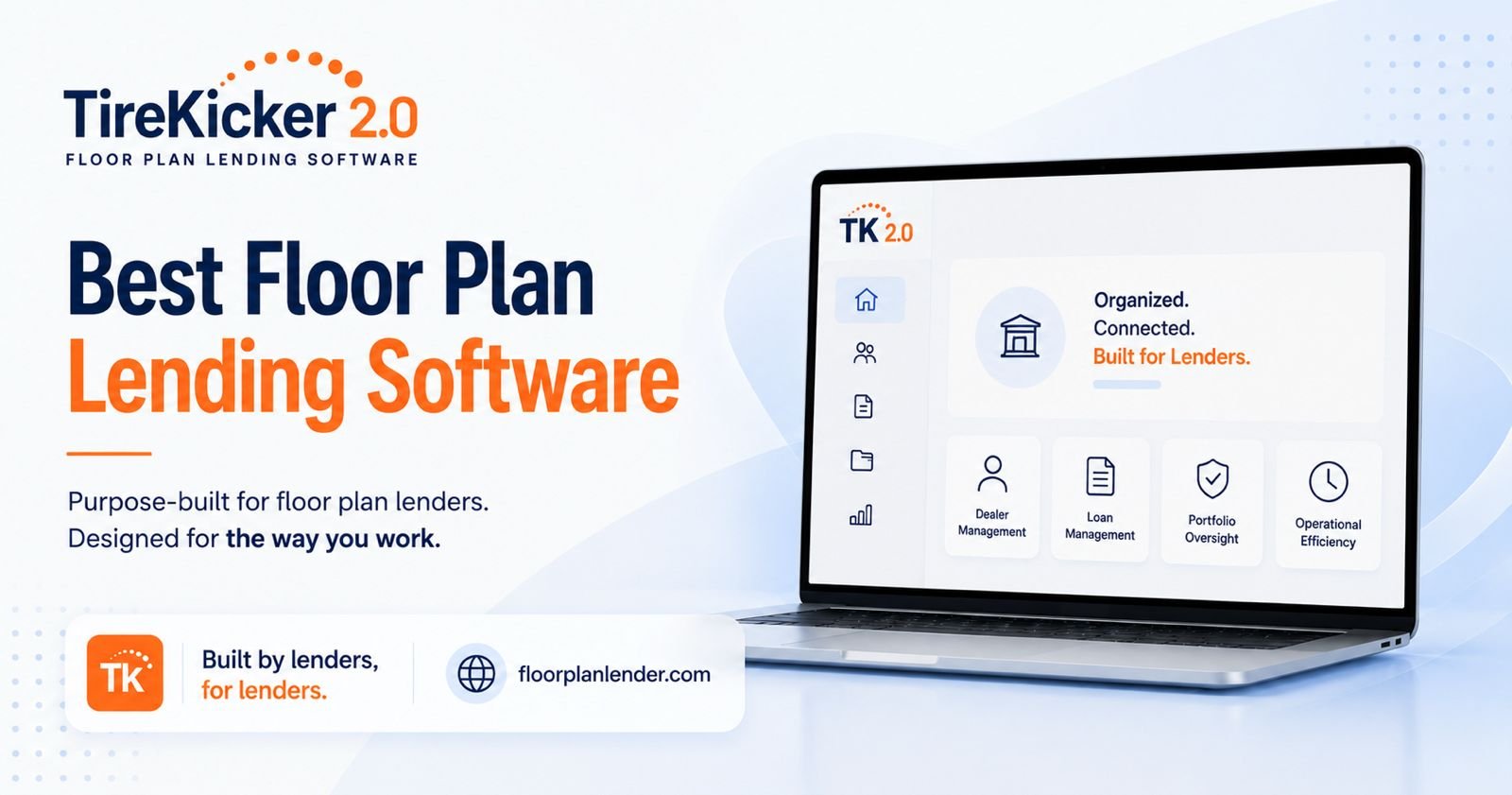
TireKicker 2.0 is a modern, cloud-based auto loan management platform specifically designed for floor plan lenders, auto finance companies, banks, and financial institutions that finance dealership inventory. Unlike traditional loan servicing software that focuses solely on loan administration, TireKicker 2.0 provides an end-to-end platform for managing advances, dealers, vehicle inventory, collateral, repayments, audits, reporting, and compliance from a single dashboard.
The platform streamlines the entire lending lifecycle, from secure dealer onboarding and advance creation to repayment tracking, inventory monitoring, title management, and audit scheduling. Dedicated portals for lenders, dealers, and administrators ensure every stakeholder has secure access to the tools and information they need, while configurable workflows help organisations adapt the platform to their operational requirements.
One of TireKicker 2.0’s biggest strengths is its comprehensive inventory and collateral management capabilities. Lenders can track financed vehicles by VIN, monitor title status, schedule audits, identify inventory discrepancies, and generate real-time reports to reduce portfolio risk. Combined with configurable dashboards, automated notifications, role-based security, and advanced analytics, the platform helps lenders improve operational efficiency while maintaining greater control over their loan portfolios.
Best For
- Floor plan lenders
- Auto finance companies
- Banks financing dealerships
- Credit unions
- Commercial vehicle finance providers
- Inventory-backed lenders
Key Features
- End-to-end advance and loan management
- Secure lender and dealer portals
- Dealer onboarding and relationship management
- Vehicle inventory and VIN tracking
- Title and collateral management
- Audit scheduling and variance reporting
- Payment tracking and repayment management
- Real-time dashboards and portfolio analytics
- Role-based user permissions and audit trails
- Automated notifications via email, SMS, and dashboard alerts
- Custom reporting with PDF and Excel exports
- Cloud-based SaaS with scalable workflows
LoanPro – Best Auto Loan Management Software for API-Driven Loan Servicing
LoanPro is a cloud-native loan servicing platform designed to help financial institutions, lenders, and fintech companies automate and manage the entire loan servicing lifecycle. Known for its flexible API-first architecture, LoanPro enables organisations to customise workflows, integrate with third-party applications, and streamline loan operations without relying on legacy systems.
The platform supports a wide range of lending products, including auto loans, personal loans, consumer finance, and commercial lending. Lenders can manage payment schedules, automate interest calculations, process recurring payments, monitor delinquencies, and generate detailed reports from a centralised dashboard. Its open API ecosystem also makes it a popular choice for businesses building custom lending solutions or integrating with existing financial technology stacks.
For organisations seeking a highly configurable loan servicing platform with strong automation capabilities, LoanPro offers the flexibility needed to support growing loan portfolios while improving operational efficiency and customer experience.
Best For
- Auto finance companies
- Consumer lenders
- Credit unions
- Fintech lenders
- Banks seeking API integrations
- Mid-sized and enterprise lending organisations
Key Features
- Loan servicing and payment management
- Automated payment processing and scheduling
- API-first architecture for custom integrations
- Interest and amortisation calculations
- Customer account management
- Delinquency and collections management
- Reporting and portfolio analytics
- Compliance and audit support
- Secure cloud-based infrastructure
- Third-party payment gateway integrations
Nortridge LMS – Best for Enterprise Loan Servicing
Nortridge Loan Management System (LMS) is an enterprise-grade lending platform built for financial institutions managing complex loan portfolios. With decades of experience in the lending industry, Nortridge provides comprehensive loan servicing capabilities that support consumer, commercial, mortgage, and auto lending operations.
The platform enables lenders to automate loan servicing, payment processing, collections, reporting, and compliance while offering extensive configuration options to match different lending models. Nortridge also integrates with payment processors, accounting systems, and customer relationship management (CRM) platforms, allowing organisations to build a connected lending ecosystem.
Its flexibility and scalability make it a preferred solution for established financial institutions that require robust servicing capabilities, advanced reporting, and enterprise-level operational controls.
Best For
- Banks
- Credit unions
- Enterprise lenders
- Commercial finance companies
- Auto finance providers
- Financial institutions with complex loan portfolios
Key Features
- Comprehensive loan servicing
- Payment processing and collections
- Loan portfolio management
- Configurable business rules
- Compliance and audit management
- Advanced reporting and analytics
- Third-party system integrations
- Customer account management
- Cloud and on-premises deployment options
- Enterprise security and access controls
TurnKey Lender – Best for Digital Lending Automation
TurnKey Lender is an AI-powered lending platform that helps financial institutions automate loan origination, underwriting, servicing, and collections through a single cloud-based solution. Designed for digital lenders, banks, credit unions, and alternative finance providers, the platform focuses on reducing manual processes while accelerating lending decisions.
Its configurable workflows allow organisations to automate borrower onboarding, credit assessments, loan approvals, payment processing, and portfolio monitoring. Built-in analytics and reporting tools provide real-time visibility into lending performance, helping businesses make informed decisions while maintaining compliance.
TurnKey Lender supports multiple lending products, including auto loans, making it a strong option for organisations looking to modernise their lending operations with automation and artificial intelligence.
Best For
- Digital lenders
- Banks
- Credit unions
- Auto finance companies
- Fintech businesses
- Organisations adopting AI-driven lending
Key Features
- Digital loan origination
- Automated underwriting workflows
- AI-powered credit decisioning
- Loan servicing and payment management
- Customer self-service portal
- Portfolio reporting and analytics
- Compliance management
- API integrations
- Cloud-based deployment
- Workflow automation
Shaw Systems – Best for Large Financial Institutions
Shaw Systems is an enterprise loan servicing platform developed for banks, credit unions, captive finance companies, and large lending institutions managing high-volume loan portfolios. The platform is designed to support complex lending operations while providing the scalability, security, and compliance features required by regulated financial organisations.
The software enables lenders to manage loan servicing, payment processing, customer accounts, collections, and reporting through configurable workflows that adapt to changing business requirements. Its enterprise architecture supports large transaction volumes while helping organisations improve operational efficiency and maintain regulatory compliance.
For financial institutions seeking a mature and scalable servicing platform, Shaw Systems offers comprehensive capabilities backed by decades of lending technology experience.
Best For
- Enterprise financial institutions
- Banks
- Captive finance companies
- Auto lenders
- Credit unions
- Large loan servicing organisations
Key Features
- Enterprise loan servicing
- Payment and collections management
- Portfolio administration
- Compliance and regulatory reporting
- Customer account management
- Workflow automation
- Advanced reporting and analytics
- Secure cloud infrastructure
- Third-party integrations
- Scalable enterprise architecture
Margill Loan Manager – Best for Interest Calculations and Loan Servicing
Margill Loan Manager is a flexible loan servicing platform designed for organisations that require accurate interest calculations and reliable loan administration. The software supports a wide range of lending scenarios, including auto loans, commercial lending, private lending, and financial agreements with customised repayment structures.
One of Margill’s biggest strengths is its advanced calculation engine, which allows lenders to manage complex interest methods, late payment calculations, amortisation schedules, and payment allocations with precision. The platform also provides tools for tracking loan balances, generating statements, managing payment histories, and producing financial reports.
While Margill does not offer specialised dealership or floor plan lending capabilities, it is a strong choice for organisations prioritising loan servicing accuracy and flexible repayment management.
Best For
- Private lenders
- Commercial finance companies
- Auto lenders
- Financial consultants
- Organisations with complex interest calculations
Key Features
- Flexible loan servicing
- Advanced interest calculation engine
- Amortisation schedule management
- Payment tracking and allocation
- Loan balance monitoring
- Financial reporting
- Customer account management
- Document generation
- Multi-currency support
- Cloud and desktop deployment options
LAPS – Best for Consumer Finance Companies
LAPS (Loan Administration and Processing System) is a loan servicing platform built to help finance companies manage consumer lending operations more efficiently. The software centralises loan administration, payment tracking, customer management, collections, and reporting, enabling lenders to streamline daily operations while maintaining better visibility into their loan portfolios.
The platform offers configurable workflows that allow organisations to adapt processes to their lending policies and operational requirements. With built-in reporting tools and payment management capabilities, LAPS helps finance companies reduce manual work while improving portfolio oversight.
Although it focuses primarily on consumer lending rather than dealer finance or inventory-backed lending, LAPS remains a practical solution for organisations seeking dependable loan servicing functionality.
Best For
- Consumer finance companies
- Personal loan providers
- Auto finance businesses
- Mid-sized lending organisations
- Regional lenders
Key Features
- Loan servicing and administration
- Customer account management
- Payment scheduling
- Delinquency monitoring
- Collections management
- Portfolio reporting
- Workflow automation
- Compliance support
- Cloud deployment
- User access controls
TValue – Best for Loan Calculations and Amortisation
TValue is a financial calculation software solution widely recognised for its loan amortisation and payment calculation capabilities. Rather than serving as a complete loan management platform, TValue specialises in helping financial professionals calculate repayment schedules, interest amounts, balloon payments, and other lending scenarios with accuracy.
Its intuitive interface makes it useful for banks, credit unions, finance companies, and consultants who need dependable financial calculations when structuring or evaluating loans. While it lacks many of the operational features found in full-scale loan management platforms, it remains a valuable tool for organisations that prioritise financial modelling and loan analysis.
Best For
- Financial institutions
- Loan officers
- Banks
- Credit unions
- Financial consultants
Key Features
- Loan amortisation calculations
- Interest calculation tools
- Balloon payment analysis
- Payment schedule generation
- Financial modelling
- Loan comparison scenarios
- Reporting tools
- User-friendly interface
- Desktop deployment
LendFoundry – Best for Digital Lending Platforms
LendFoundry is a cloud-based lending platform that helps financial institutions digitise the lending lifecycle through configurable workflows and automation. Supporting both consumer and commercial lending, the platform combines loan origination, underwriting, servicing, collections, and reporting into a single ecosystem.
Its modular architecture enables organisations to tailor workflows based on their lending products while integrating with third-party systems such as payment gateways, credit bureaus, and customer relationship management platforms. LendFoundry also provides real-time dashboards and analytics that help lenders monitor portfolio performance and improve operational efficiency.
For organisations undergoing digital transformation, LendFoundry offers a flexible platform that can scale as lending operations expand.
Best For
- Digital lenders
- Banks
- Credit unions
- Fintech companies
- Commercial lenders
Key Features
- Digital loan origination
- Loan servicing
- Workflow automation
- Underwriting management
- Collections management
- Customer portal
- Reporting and analytics
- API integrations
- Cloud-based architecture
- Compliance management
Bryt Software – Best for Private and Commercial Lenders
Bryt Software is a cloud-based loan management platform developed for private lenders, hard money lenders, commercial finance companies, and organisations managing smaller loan portfolios. The software simplifies loan servicing by providing tools for payment tracking, document management, borrower communication, and portfolio reporting within an easy-to-use interface.
Its streamlined design allows lenders to automate routine administrative tasks while maintaining visibility into active loans and payment histories. Bryt Software also supports custom loan structures, making it suitable for organisations that require flexibility without the complexity of enterprise-level systems.
Although it is not specifically designed for dealership finance or floor plan lending, Bryt Software is a solid choice for lenders seeking an intuitive and affordable loan management solution.
Best For
- Private lenders
- Hard money lenders
- Commercial finance companies
- Small lending businesses
- Real estate lenders
Key Features
- Loan servicing and administration
- Payment tracking
- Borrower management
- Document management
- Portfolio reporting
- Workflow automation
- Cloud-based platform
- User permissions
- Loan history tracking
- Custom loan configurations
How to Choose the Best Auto Loan Management Software
Selecting the right auto loan management software is about more than comparing features—it’s about choosing a platform that aligns with your lending model, operational workflows, and long-term business goals. The right solution should help your organisation automate processes, reduce risk, improve portfolio visibility, and deliver a better experience for both employees and customers.
Whether you’re a bank, credit union, auto finance company, or floor plan lender, here are the key factors to consider before investing in a loan management platform.
Look for End-to-End Loan Management
A modern lending platform should support the entire loan lifecycle rather than focusing on just one stage of the process.
Look for software that enables you to:
- Create and manage loans
- Track repayments
- Calculate interest
- Process early payoffs
- Monitor outstanding balances
- Handle loan modifications
- Manage delinquent accounts
Having everything within a single platform eliminates duplicate work, reduces errors, and provides better visibility into your loan portfolio.
Consider Your Lending Model
Not every loan management platform is designed for the same type of lender.
For example:
- Banks often require enterprise-level servicing, compliance, and reporting.
- Credit unions typically prioritise member experience and payment automation.
- Consumer finance companies need efficient loan servicing and collections.
- Floor plan lenders require inventory tracking, dealer management, title tracking, and collateral monitoring.
Choosing software built for your specific lending model will reduce customisation costs and improve operational efficiency.
Evaluate Automation Capabilities
Manual processes slow down operations and increase the likelihood of errors.
The best platforms automate repetitive tasks such as:
- Payment reminders
- Interest calculations
- Repayment schedules
- Loan status updates
- Notifications
- Report generation
- Collections workflows
Automation allows your team to spend less time on administrative work and more time supporting customers and growing the business.
Prioritise Reporting and Analytics
Accurate reporting is essential for making informed lending decisions.
Choose software that provides:
- Portfolio dashboards
- Delinquency reports
- Payment history
- Dealer or customer performance
- Financial summaries
- Compliance reports
- Custom reporting options
- Export capabilities
Real-time insights help identify trends, monitor portfolio health, and improve strategic decision-making.
Ensure Strong Security and Compliance
Auto loan management systems store sensitive financial and customer information, making security a top priority.
Look for features such as:
- Role-based user permissions
- Multi-factor authentication (MFA)
- Audit trails
- Activity logging
- Data encryption
- Secure document storage
- Automated backups
- Compliance reporting
A secure platform helps protect customer data while supporting regulatory requirements and internal governance.
Choose Software That Can Scale
Your software should support your business not only today but also as it grows.
A scalable platform should allow you to:
- Add more users
- Manage larger loan portfolios
- Support multiple branches or locations
- Expand into new lending products
- Handle increasing transaction volumes
- Integrate with future technologies
Cloud-based platforms often provide greater flexibility and make it easier to scale without significant infrastructure investments.
Look for Integration Capabilities
Most lenders rely on multiple systems to run their business.
Choosing software that integrates with your existing technology stack can reduce manual work and improve operational efficiency.
Common integrations include:
- Accounting software
- Payment gateways
- ACH processing
- CRM platforms
- Credit bureaus
- Identity verification services
- Business intelligence tools
- APIs for custom applications
The more connected your systems are, the more efficient your lending operation becomes.
Consider the User Experience
Even the most feature-rich platform will struggle to deliver value if it’s difficult to use.
When evaluating software, consider:
- Dashboard design
- Ease of navigation
- Search functionality
- Mobile accessibility
- User training resources
- Customer support
- Implementation assistance
An intuitive platform reduces training time and encourages higher adoption across your organisation.
Assess Industry-Specific Features
Some lenders require specialised capabilities beyond standard loan servicing.
For example, floor plan lenders and inventory finance companies may benefit from features such as:
- Dealer management
- Vehicle inventory tracking
- VIN search
- Title management
- Audit scheduling
- Collateral monitoring
- Dealer performance reporting
- Inventory ageing reports
Selecting industry-specific software can significantly improve operational efficiency while reducing portfolio risk.
Evaluate the Vendor, Not Just the Software
A software platform is a long-term investment, so it’s important to evaluate the company behind the product as well.
Before making a decision, consider:
- Industry experience
- Product roadmap
- Customer support quality
- Training resources
- Security practices
- Frequency of software updates
- Customer reviews
- Implementation services
A reliable technology partner can help ensure your software continues to meet your needs as your business evolves.
Which Auto Loan Management Software Is Right for You?
The best software depends on your organisation’s size, lending model, and operational priorities.
If you’re a floor plan lender or dealer finance company, a specialised platform like TireKicker 2.0 offers advanced capabilities for managing dealer relationships, vehicle inventory, collateral, audits, and repayments from one centralised system.
If you focus on consumer lending, platforms such as LoanPro or TurnKey Lender provide strong loan servicing and automation features.
For enterprise financial institutions, Nortridge LMS and Shaw Systems deliver scalable servicing capabilities for managing large and complex loan portfolios.
If your primary need is loan servicing or financial calculations, solutions like Margill Loan Manager or TValue may better align with your operational requirements.
By identifying your business needs and comparing platforms against the criteria outlined above, you can confidently select a solution that supports both your current operations and future growth.
In the next section, we’ll answer some of the most frequently asked questions about auto loan management software, including pricing, key features, implementation considerations, and how these platforms help lenders improve operational efficiency.
How to Choose the Best Auto Loan Management Software
Selecting the right auto loan management software is about more than comparing features about choosing a platform that aligns with your lending model, operational workflows, and long-term business goals. The right solution should help your organisation automate processes, reduce risk, improve portfolio visibility, and deliver a better experience for both employees and customers.
Whether you’re a bank, credit union, auto finance company, or floor plan lender, here are the key factors to consider before investing in a loan management platform.
Look for End-to-End Loan Management
A modern lending platform should support the entire loan lifecycle rather than focusing on just one stage of the process.
Look for software that enables you to:
- Create and manage loans
- Track repayments
- Calculate interest
- Process early payoffs
- Monitor outstanding balances
- Handle loan modifications
- Manage delinquent accounts
Having everything within a single platform eliminates duplicate work, reduces errors, and provides better visibility into your loan portfolio.
Consider Your Lending Model
Not every loan management platform is designed for the same type of lender.
For example:
- Banks often require enterprise-level servicing, compliance, and reporting.
- Credit unions typically prioritise member experience and payment automation.
- Consumer finance companies need efficient loan servicing and collections.
- Floor plan lenders require inventory tracking, dealer management, title tracking, and collateral monitoring.
Choosing software built for your specific lending model will reduce customisation costs and improve operational efficiency.
Evaluate Automation Capabilities
Manual processes slow down operations and increase the likelihood of errors.
The best platforms automate repetitive tasks such as:
- Payment reminders
- Interest calculations
- Repayment schedules
- Loan status updates
- Notifications
- Report generation
- Collections workflows
Automation allows your team to spend less time on administrative work and more time supporting customers and growing the business.
Prioritise Reporting and Analytics
Accurate reporting is essential for making informed lending decisions.
Choose software that provides:
- Portfolio dashboards
- Delinquency reports
- Payment history
- Dealer or customer performance
- Financial summaries
- Compliance reports
- Custom reporting options
- Export capabilities
Real-time insights help identify trends, monitor portfolio health, and improve strategic decision-making.
Ensure Strong Security and Compliance
Auto loan management systems store sensitive financial and customer information, making security a top priority.
Look for features such as:
- Role-based user permissions
- Multi-factor authentication (MFA)
- Audit trails
- Activity logging
- Data encryption
- Secure document storage
- Automated backups
- Compliance reporting
A secure platform helps protect customer data while supporting regulatory requirements and internal governance.
Choose Software That Can Scale
Your software should support your business not only today but also as it grows.
A scalable platform should allow you to:
- Add more users
- Manage larger loan portfolios
- Support multiple branches or locations
- Expand into new lending products
- Handle increasing transaction volumes
- Integrate with future technologies
Cloud-based platforms often provide greater flexibility and make it easier to scale without significant infrastructure investments.
Look for Integration Capabilities
Most lenders rely on multiple systems to run their business.
Choosing software that integrates with your existing technology stack can reduce manual work and improve operational efficiency.
Common integrations include:
- Accounting software
- Payment gateways
- ACH processing
- CRM platforms
- Credit bureaus
- Identity verification services
- Business intelligence tools
- APIs for custom applications
The more connected your systems are, the more efficient your lending operation becomes.
Consider the User Experience
Even the most feature-rich platform will struggle to deliver value if it’s difficult to use.
When evaluating software, consider:
- Dashboard design
- Ease of navigation
- Search functionality
- Mobile accessibility
- User training resources
- Customer support
- Implementation assistance
An intuitive platform reduces training time and encourages higher adoption across your organisation.
Assess Industry-Specific Features
Some lenders require specialised capabilities beyond standard loan servicing.
For example, floor plan lenders and inventory finance companies may benefit from features such as:
- Dealer management
- Vehicle inventory tracking
- VIN search
- Title management
- Audit scheduling
- Collateral monitoring
- Dealer performance reporting
- Inventory ageing reports
Selecting industry-specific software can significantly improve operational efficiency while reducing portfolio risk.
Evaluate the Vendor, Not Just the Software
A software platform is a long-term investment, so it’s important to evaluate the company behind the product as well.
Before making a decision, consider:
- Industry experience
- Product roadmap
- Customer support quality
- Training resources
- Security practices
- Frequency of software updates
- Customer reviews
- Implementation services
A reliable technology partner can help ensure your software continues to meet your needs as your business evolves.
Which Auto Loan Management Software Is Right for You?
The best software depends on your organisation’s size, lending model, and operational priorities.
If you’re a floor plan lender or dealer finance company, a specialised platform like TireKicker 2.0 offers advanced capabilities for managing dealer relationships, vehicle inventory, collateral, audits, and repayments from one centralised system.
If you focus on consumer lending, platforms such as LoanPro or TurnKey Lender provide strong loan servicing and automation features.
For enterprise financial institutions, Nortridge LMS and Shaw Systems deliver scalable servicing capabilities for managing large and complex loan portfolios.
If your primary need is loan servicing or financial calculations, solutions like Margill Loan Manager or TValue may better align with your operational requirements.
By identifying your business needs and comparing platforms against the criteria outlined above, you can confidently select a solution that supports both your current operations and future growth.
In the next section, we’ll answer some of the most frequently asked questions about auto loan management software, including pricing, key features, implementation considerations, and how these platforms help lenders improve operational efficiency.
Final Verdict
The auto lending industry continues to evolve as lenders face increasing demands for operational efficiency, regulatory compliance, and better portfolio visibility. Investing in the right auto loan management software is no longer just a technology upgrade—it’s a strategic decision that can improve productivity, reduce risk, and support long-term business growth.
Each platform featured in this guide offers unique strengths. Some excel at consumer loan servicing, while others focus on enterprise lending or digital loan automation. The best choice ultimately depends on your lending model, business objectives, and operational requirements.
If your organisation primarily manages consumer auto loans, platforms like LoanPro, TurnKey Lender, or Nortridge LMS provide robust loan servicing and automation capabilities.
However, if your business specialises in floor plan lending, dealer financing, or inventory-backed lending, you’ll benefit most from a platform designed specifically for those workflows.
That’s where TireKicker 2.0 stands out.
Unlike many traditional loan servicing platforms, TireKicker 2.0 combines advance management, dealer onboarding, inventory tracking, title management, audit scheduling, repayment tracking, reporting, and compliance tools into a single cloud-based solution. Rather than managing multiple disconnected systems, lenders can oversee their entire financing operation from one centralised platform.
Whether you’re financing a handful of dealerships or managing a growing nationwide portfolio, TireKicker 2.0 provides the visibility, automation, and operational control needed to simplify complex lending processes while improving collaboration with dealer partners.
If you’re looking for software built specifically for the realities of floor plan lending and dealership finance, TireKicker 2.0 is a solution worth exploring.
Ready to Modernise Your Lending Operations?
If you’re evaluating auto loan management software for your organisation, now is the ideal time to see what a purpose-built platform can do.
With TireKicker 2.0, you can:
- Simplify advance and loan management
- Streamline dealer onboarding and communication
- Track financed vehicle inventory and collateral
- Automate audits and compliance workflows
- Monitor repayments and portfolio performance in real time
- Generate powerful reports and analytics
- Scale confidently as your lending business grows
Book a personalised demo to see how TireKicker 2.0 can help your organisation improve efficiency, strengthen compliance, and gain greater control over every stage of the lending lifecycle.
Visit FloorPlanLender.com to learn more and request a demo.
Frequently Asked Questions
What is auto loan management software?
Auto loan management software is a digital platform that helps lenders manage the complete lifecycle of an auto loan, including loan origination, servicing, payment tracking, reporting, compliance, and customer or dealer management. Modern platforms also automate many manual processes, improving operational efficiency and reducing administrative work.
Who uses auto loan management software?
Auto loan management software is commonly used by:
- Banks
- Credit unions
- Auto finance companies
- Floor plan lenders
- Commercial finance companies
- Independent lenders
- Captive finance companies
Each organisation uses the software to streamline lending operations, improve reporting, and manage loan portfolios more effectively.
What features should I look for in auto loan management software?
Key features include:
- Loan and advance management
- Payment tracking
- Dealer or borrower portals
- Reporting and analytics
- Document management
- Compliance tools
- Role-based security
- Automated notifications
- Workflow automation
- API integrations
- Audit trails
For floor plan lenders, additional features such as inventory tracking, VIN management, title management, and audit scheduling are also important.
What is the difference between loan origination and loan servicing?
Loan origination covers the process of creating and approving a loan, including applications, underwriting, credit evaluation, and funding.
Loan servicing begins after the loan has been issued and includes managing repayments, calculating interest, monitoring balances, handling customer communications, and processing payoffs or modifications.
Many modern platforms support both functions within a single system.
What is floor plan lending?
Floor plan lending is a type of inventory financing used by vehicle dealerships. Instead of purchasing inventory outright, dealerships receive financing from a lender to acquire vehicles for sale.
The lender retains an interest in the financed inventory until the dealership repays the advance, making inventory tracking, title management, and regular audits essential parts of the lending process.
Is cloud-based auto loan management software secure?
Yes. Most modern cloud-based platforms include enterprise-grade security features such as:
- Data encryption
- Role-based access control
- Multi-factor authentication
- Audit trails
- Secure backups
- Activity logging
However, organisations should always evaluate a vendor’s security practices and compliance standards before selecting a platform.
Can auto loan management software automate payment tracking?
Yes. Most platforms automate payment schedules, calculate outstanding balances, send payment reminders, record payment history, and monitor overdue accounts.
Automation reduces manual work, improves collection efficiency, and helps lenders maintain accurate financial records.
Can the software manage dealer relationships?
Some platforms include dedicated dealer management capabilities that allow lenders to onboard dealerships, monitor performance, manage communications, track financing, and provide secure dealer portals.
Solutions designed for floor plan lending typically offer more advanced dealer management functionality than general loan servicing software.
How does auto loan management software improve compliance?
These platforms help lenders maintain compliance by providing secure document storage, user activity logs, audit trails, configurable approval workflows, reporting tools, and role-based permissions.
Many systems also simplify internal audits by maintaining a complete history of user actions and financial transactions.
Is TireKicker 2.0 suitable for small and growing lenders?
Yes. TireKicker 2.0 is designed to support organisations of different sizes, from growing lending businesses to established financial institutions. Its cloud-based architecture, configurable workflows, dealer management tools, inventory tracking, and reporting capabilities allow lenders to scale operations without moving to a different platform as their portfolios expand.


