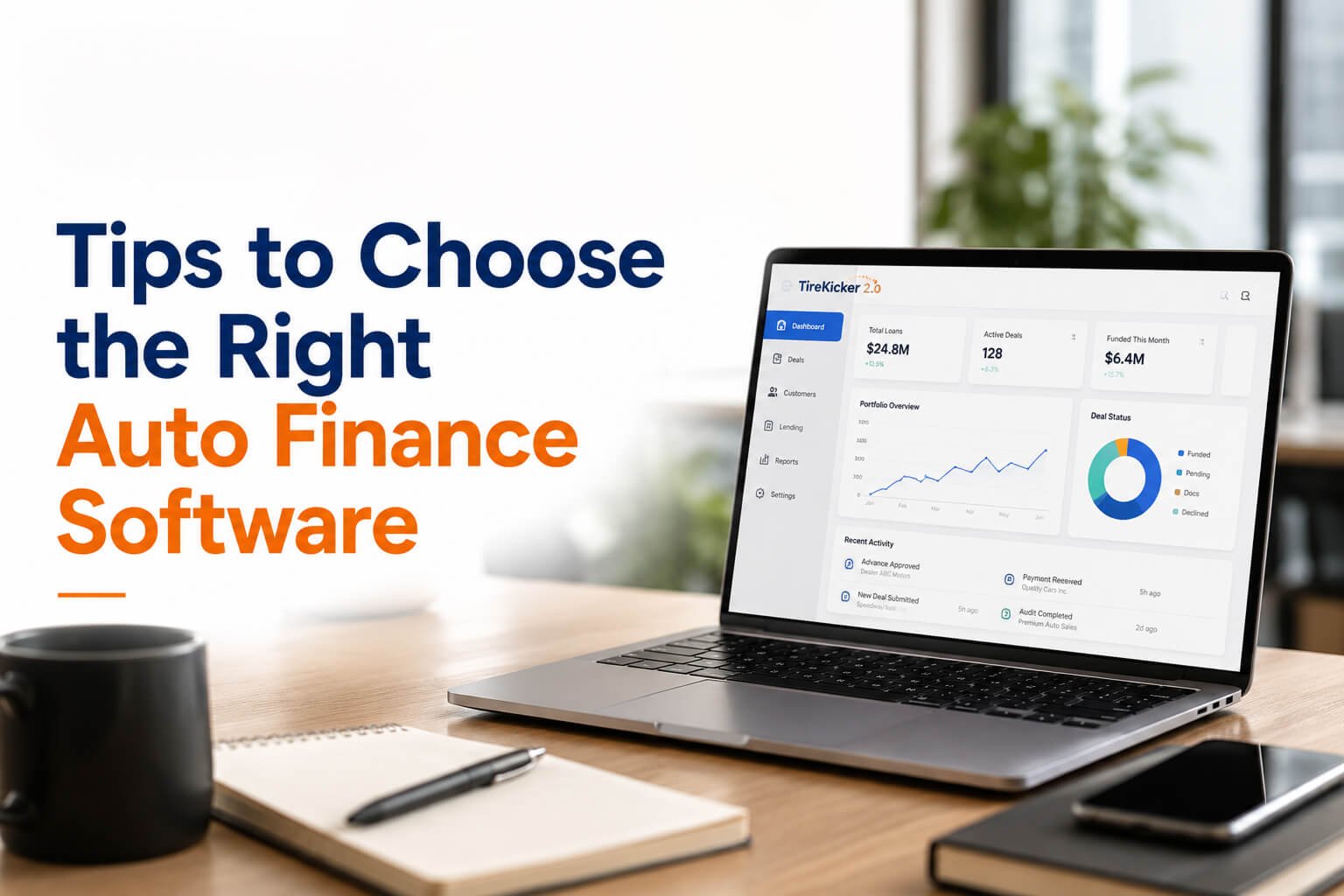
Choosing the right auto finance software is an important decision for car lenders, dealerships, automotive finance companies, and floor-plan lenders. The right platform can help your team manage loans, vehicle inventory, payments, collateral, dealer relationships, reporting, and day-to-day lending operations more efficiently.
But with so many software options available, how do you know which solution is right for your business?
The answer isn’t simply to choose the platform with the most features or the lowest price. The best auto finance software should fit your lending model, simplify your workflows, integrate with the systems you already use, and scale as your business grows.
It’s also important to understand that automotive finance software can serve different purposes. A lender managing consumer auto loans may have different requirements from a company financing vehicle inventory for dealerships. Similarly, car finance broker software may focus on applications and lender relationships rather than loan and collateral management.
In this guide, we’ll explain what to look for when choosing automotive finance software and how to evaluate vehicle finance, dealer financing, and floorplan lending solutions.
What Is Automotive Finance Software?
Auto finance software is a technology platform designed to help automotive businesses manage financing activities throughout the loan lifecycle.
Depending on the business model, vehicle finance software can help manage everything from loan and advance tracking to payments, collateral, documentation, reporting, and other lending workflows.
For automotive lenders, the requirements can be more specialized than those of a traditional lending business. A lender may need to manage dealers, vehicles, VINs, floor-plan advances, titles, collateral, payments, audits, inventory, and financial records from a centralized system.
That’s why choosing software that understands the specific workflows of automotive lending is important.
Types of Automotive Finance Software
The term “automotive finance software” can describe several different types of technology. Before comparing providers, it’s important to understand which type of software your business actually needs.
Vehicle Finance Management Software
Vehicle finance management software helps lenders manage financing associated with vehicles throughout the loan lifecycle.
Depending on the platform, capabilities may include:
- Loan and account management
- Payment tracking
- Interest and fee calculations
- Vehicle and VIN information
- Collateral management
- Documentation
- Reporting
- Account and portfolio monitoring
If your business manages vehicle-related loans, look for a platform that can connect financial information with the vehicle and collateral securing the loan.
Auto Finance Management Software
Auto finance management software is a broader term that can refer to platforms used to manage automotive lending operations.
Depending on the lender’s business model, this may include:
- Loan management
- Advances
- Payments
- Billing
- Interest calculations
- Account balances
- Reporting
- Dealer management
- Collateral
- Workflow automation
The important consideration is not simply whether a vendor calls its product “auto finance management software.” Evaluate whether its actual functionality matches your lending operation.
Car Finance Broker Software
Car finance broker software serves a different purpose from software designed for lenders that finance dealership inventory.
Broker-focused systems may help manage:
- Customer applications
- Lender relationships
- Deal submissions
- Customer and vehicle information
- Documentation
- Application status
- Commissions
- Communication workflows
If your business operates as a finance broker, these capabilities may be more important than dealer inventory, floor-plan advances, and collateral audits.
Auto Dealer Financing Software
Auto dealer financing software is designed around financing transactions involving automotive dealerships.
Depending on the solution, it may support dealer relationships, financing workflows, loan management, vehicle information, payments, and reporting.
Lenders working directly with dealerships should evaluate how well the software handles dealer-specific information and whether it provides visibility into dealer exposure, financed vehicles, and outstanding balances.
Floorplan Lending Software
Floorplan lending software is designed specifically for lenders that finance vehicle inventory held by automotive dealers.
This is a specialized type of automotive finance software because the lender needs to maintain a relationship between the dealer, credit line, advance, vehicle, VIN, collateral, payment activity, and inventory status.
Important capabilities may include:
- Dealer credit lines
- Floor-plan advances
- Vehicle and VIN tracking
- Inventory management
- Title and collateral management
- Dealer audits and inspections
- Payoffs
- Billing and payments
- Aging inventory
- Dealer exposure
- Portfolio reporting
For a floor-plan lender, choosing general-purpose loan software that does not understand these relationships can result in manual workarounds and disconnected processes.
Why Choosing the Right Auto Finance Software Matters
Automotive lending involves large amounts of financial and vehicle-related information. Managing that information across spreadsheets, disconnected applications, emails, and manual processes can create unnecessary operational challenges.
For lenders looking to streamline these workflows, reducing manual loan processing can be an important starting point.
A centralized software platform can give your team better visibility into loans, vehicles, dealers, payments, and outstanding balances while reducing repetitive administrative work.
For floor-plan lenders in particular, the connection between the loan and the vehicle securing that loan is critical. Your software should make it easy to see how individual vehicles, advances, dealers, payments, and collateral relate to one another.
The goal isn’t simply to replace spreadsheets. The right system should create a more consistent workflow for managing the entire lending operation.
Things to Consider When Choosing Auto Finance Software
Look for Software Built for Automotive Lending
The first question to ask is whether the platform was actually designed for the automotive finance industry.
Generic loan management software may provide basic capabilities such as payment tracking and account management, but automotive lenders often have additional requirements.
Your software may need to manage:
- Vehicles and VINs
- Dealers
- Floor-plan advances
- Vehicle inventory
- Titles
- Collateral
- Payments
- Audits and inspections
- Billing
- Loan balances
- Financial reporting
For floor-plan lenders, these functions are closely connected.
A platform designed specifically around automotive lending can reduce the need for workarounds and extensive customization.
When evaluating vendors, ask:
- Was the system built specifically for automotive finance?
- Does it support vehicle-level information?
- Can it manage dealer relationships?
- Does it support floor-plan lending if required?
- Can it connect loans or advances to individual vehicles?
- Does the platform support the workflows your team uses every day?
The closer the software matches your existing lending model, the less likely your team will need manual processes to fill gaps.
Evaluate Loan and Inventory Management
Loan management should be one of the first areas you evaluate.
Your team should be able to quickly answer questions such as:
- How many active loans or advances do we have?
- Which dealer is associated with each account?
- Which vehicles are currently financed?
- What is the outstanding balance?
- How long has inventory been outstanding?
- Which accounts require attention?
- What payments have been made?
- What collateral is associated with each loan or advance?
A strong vehicle finance management software platform should provide a centralized view of this information.
This can be particularly important for floor-plan lenders because inventory changes frequently. Vehicles may be sold, moved, paid down, or otherwise require updates to the lender’s records.
Instead of relying on disconnected spreadsheets and manual updates, a centralized system can help your team maintain a more consistent view of the portfolio.
Check Vehicle and VIN-Level Tracking
Vehicle-level tracking is an important consideration for lenders financing automotive inventory.
A floor-plan lender may need to know not only how much a dealer owes, but also which vehicles make up the collateral supporting that exposure.
Look for software that can help your team track information such as:
- VIN
- Vehicle make and model
- Vehicle status
- Advance amount
- Loan or account information
- Dealer
- Title information
- Payoff status
- Inventory status
- Relevant transaction history
VIN-level visibility can make it easier to connect financial activity with the physical collateral supporting the loan.
For businesses searching specifically for vehicle floorplan finance software, this is one of the most important capabilities to evaluate.
Evaluate Dealer Management Capabilities
If your business provides financing to dealerships, dealer management should be another major consideration.
Your software may need to maintain information about:
- Dealer accounts
- Dealer locations
- Credit limits
- Contacts
- Outstanding balances
- Financed inventory
- Payment history
- Dealer exposure
- Audit activity
- Account status
Auto dealer financing software should make it easy for your team to understand each dealer’s relationship with your lending organization.
Ask vendors to demonstrate how dealer information connects to loans, vehicles, advances, payments, and reporting.
The goal is to avoid maintaining dealer information separately from the financial and collateral information associated with that dealer.
Evaluate Floorplan Finance and Advance Management
If your business provides floor-plan financing, this should receive particular attention during your software evaluation.
Floorplan finance software needs to support workflows that are different from ordinary loan servicing.
A lender may need to manage:
- Credit lines
- Floor-plan advances
- Vehicle additions
- Vehicle payoffs
- Inventory balances
- Curtailments
- Interest
- Fees
- Dealer exposure
- Collateral
- Audits
- Inventory aging
The software should allow your team to understand how individual advances affect the dealer’s overall exposure.
Ask potential vendors to demonstrate a complete floor-plan workflow rather than simply showing a list of features.
For example, ask them to demonstrate how a vehicle is added, financed, tracked as collateral, included in dealer exposure, and eventually paid off.
Check Billing and Payment Capabilities
Payments are at the center of any lending operation.
When evaluating software, look beyond basic payment recording. Consider how the system handles the complete billing and payment workflow.
Important capabilities may include:
- Automated billing
- Payment tracking
- Interest calculations
- Fee management
- Account balances
- Payment history
- Transaction records
- Payment reporting
Automation can reduce repetitive data entry and help minimize errors caused by manual calculations.
Ask potential vendors to demonstrate how a payment moves through the system from entry to account update, balance calculation, and reporting.
For floor-plan lenders, also consider how payments and payoffs affect vehicle-level and dealer-level balances.
Consider Title and Collateral Management
For automotive lenders, collateral management is a critical part of the lending process.
A vehicle may represent a significant portion of the lender’s exposure. Your software should therefore make it easy to identify and manage the collateral associated with each loan or advance.
Look for capabilities that help your team manage:
- Vehicle information
- VINs
- Titles
- Collateral status
- Dealer information
- Loan-to-vehicle relationships
- Documentation
- Missing or incomplete information
Having this information centralized can make it easier for lending teams to monitor collateral and identify issues that require attention.
For floor-plan lenders, the relationship between the financial account and the underlying vehicle inventory is particularly important.
Prioritize Audit and Compliance Workflows
Compliance should be considered during the software-selection process, not after implementation.
Depending on the type of lending your business conducts, your operations may involve requirements related to areas such as consumer reporting, privacy, fair lending, recordkeeping, and other applicable regulations.
Software cannot guarantee compliance on its own. However, a well-designed platform can help create more consistent processes and maintain organized records.
When evaluating software, look for:
- Audit trails
- User permissions
- Transaction history
- Documentation
- Reporting
- Recordkeeping
- Configurable workflows
- Data security controls
For floor-plan lenders, audit functionality can also be important for monitoring financed inventory and maintaining visibility into collateral.
Ask vendors to explain what information the system records, how user activity is tracked, and how historical records can be accessed.
Evaluate Integrations
Your auto finance software shouldn’t have to operate in isolation.
Automotive businesses often rely on several technology systems, including dealership management, accounting, payment, document, credit, and other business applications.
That makes integrations an important consideration.
Ask potential software providers:
- Does the platform integrate with our existing systems?
- Does it support APIs?
- Can it connect with our accounting software?
- Can it integrate with payment systems?
- Can data be transferred between our dealership and lending systems?
- How are integrations maintained?
- Is integration work included in implementation or charged separately?
For lenders working closely with dealerships, understanding how dealer management software fits into the broader technology ecosystem can also help when evaluating integration requirements.
Good integrations can reduce duplicate data entry and help your teams work from more consistent information.
Look for Cloud-Based Accessibility
Modern lending teams may need access to business information from different locations and devices.
A cloud-based platform can provide centralized access to authorized users without requiring the software to be tied to a specific office computer or local server.
When evaluating a cloud-based auto finance solution, ask about:
- Data security
- User authentication
- Access controls
- Data backups
- System availability
- Disaster recovery
- Data ownership
- Security practices
Accessibility is important, but it should always be considered alongside security and data protection.
Make Sure the Software Can Scale With Your Business
The platform that works for a small lending operation may not be suitable once your portfolio grows.
Think about where your business is heading—not only where it is today.
Consider questions such as:
- Can the platform support more loans?
- Can we add more dealers?
- Can we add users as our team grows?
- Can the system support additional collateral?
- Can reporting scale with our portfolio?
- Can we expand into new lending products?
- Will we need to replace the system as the business grows?
Scalability isn’t only about the number of accounts a platform can technically support.
It also includes whether your workflows, reporting, integrations, user permissions, and operational processes can continue to work efficiently as your lending business expands.
Choosing scalable software can help you avoid another major technology migration in the future.
Compare the Total Cost, Not Just the Subscription Price
Price is important, but the monthly or annual subscription is only one part of the total cost.
When comparing auto finance platforms, consider:
- Subscription fees
- Implementation costs
- Data migration
- Integrations
- Training
- Customer support
- Additional users
- Custom development
- Transaction or usage fees
- Future upgrades
A platform that appears inexpensive can become costly if employees have to perform significant manual work.
On the other hand, a more expensive system may not provide good value if your team doesn’t need most of its features.
The goal is to find a platform that provides the functionality your business actually needs at a sustainable total cost.
Request a Real Product Demonstration
Don’t choose auto finance software based solely on a feature list.
Ask the vendor to demonstrate real workflows that match your business.
For example, ask them to show how the system handles:
- Creating a new loan or advance
- Adding a vehicle
- Recording a VIN
- Associating collateral with the account
- Managing dealer information
- Recording a payment
- Calculating balances
- Managing billing
- Performing an audit
- Generating reports
- Reviewing an account from start to finish
If you’re evaluating floorplan lending software, ask the vendor to demonstrate a complete vehicle financing workflow.
A live demonstration can reveal usability issues that may not be obvious from a product page.
It also gives your team an opportunity to see whether the platform actually matches the way your business operates.
Why TireKicker 2.0 Is Built for Floor-Plan Lenders
TireKicker 2.0 is designed specifically for floor-plan lending and automotive finance operations.
The platform brings key lending workflows together in one cloud-based system, helping lenders manage loans, inventory, dealers, payments, collateral, and operational processes.
For lenders whose primary business involves financing dealership inventory, the platform is designed around the relationships between dealers, vehicles, advances, collateral, and loan activity.
Loan & Inventory Management
Track advances, vehicles, inventory, dealers, and loan information from a centralized platform.
This can give lending teams greater visibility into financed inventory and outstanding balances.
Billing & Payment Processing
Manage billing and payment workflows while maintaining visibility into account activity and balances.
Centralized payment information can help reduce the need to maintain separate records across spreadsheets and disconnected systems.
Audit & Compliance
Support audit-related processes with organized records, transaction information, and operational visibility.
A centralized system can help your team maintain more consistent records and review account activity.
Title & Collateral Management
Manage vehicle collateral and title-related information as part of the lending workflow.
Keeping vehicle, VIN, collateral, and account information connected can help lenders maintain a clearer view of their portfolio.
Scalable Architecture
Support your business as your lending portfolio, dealer network, users, and lending requirements grow.
When evaluating any software platform, consider not only your current needs but also how the system will support future growth.
Cloud-Based Access
Access your lending operations through a modern SaaS platform rather than relying on disconnected local systems.
For lenders looking to modernize existing processes, TireKicker 2.0 provides a purpose-built approach to managing floor-plan lending operations.
Final Thoughts
Choosing the right auto finance software is an important decision for any U.S. car lender, dealership, automotive finance company, or floor-plan financing business.
The right platform should do more than track loan payments. It should help your team manage loans, vehicles, dealers, collateral, billing, audits, payments, and reporting while reducing unnecessary manual work.
Start by identifying your biggest operational challenges. Then evaluate software based on automotive-specific functionality, integrations, security, scalability, usability, and total cost of ownership.
It’s also important to choose software that matches your lending model. A car finance broker may need application and lender-management tools, while a floor-plan lender may require vehicle-level collateral tracking, dealer management, advances, inventory management, audits, and payoffs.
For floor-plan lenders, choosing software built around automotive lending workflows can provide a significant advantage over trying to adapt a generic loan management system to your business.
TireKicker 2.0 combines decades of floor-plan lending experience with a modern cloud-based platform designed to help automotive lenders manage their operations with greater control and visibility.


