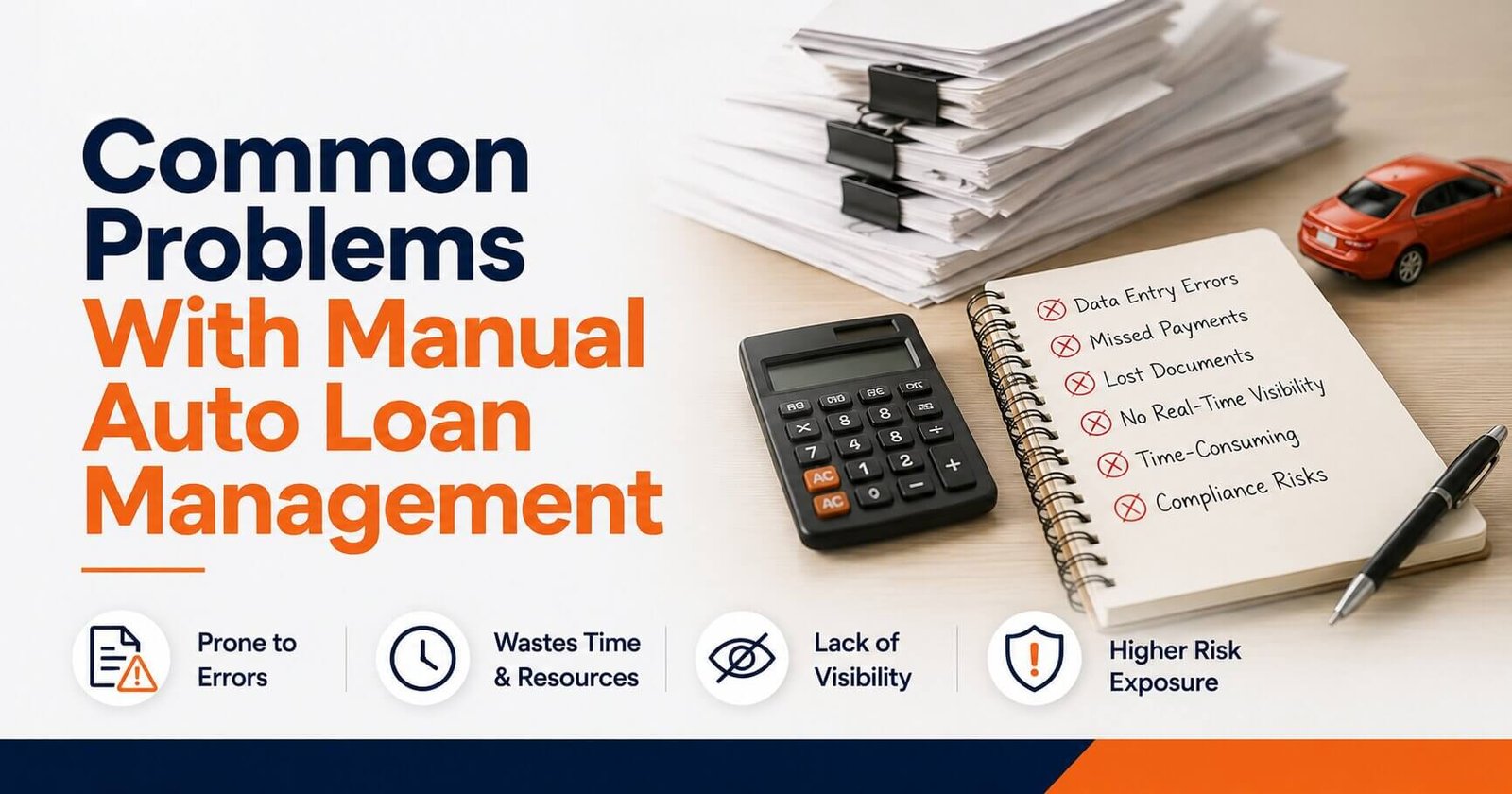
Managing auto loans involves much more than tracking balances and collecting payments. For automotive lenders, the day-to-day process can involve loan records, dealer accounts, vehicle inventory, VINs, payments, titles, audits, documentation, reporting, and ongoing communication.
When these activities are managed manually, lenders often rely on spreadsheets, emails, paper documents, disconnected systems, and repetitive data entry. These tools may work when a portfolio is small, but they can become increasingly difficult to manage as the business grows.
The problem isn’t necessarily the use of manual processes themselves. The real challenge is what happens when manual processes become the foundation of an increasingly complex lending operation.
Data can become fragmented. Employees may spend hours performing repetitive administrative tasks. Reporting can take longer. Errors can be harder to identify. And management may not have a clear, up-to-date view of the loan portfolio.
For US auto lenders and automotive finance companies, recognizing these challenges is the first step toward building a more efficient and scalable operation.
Let’s look at the most common problems with manual auto loan management and how lenders can address them.
Manual Data Entry Increases the Risk of Errors
Data entry is one of the most repetitive activities in loan management.
An auto lender may need to enter and update information related to borrowers, dealers, vehicles, VINs, loan amounts, payments, fees, titles, collateral, and account activity.
When employees have to enter the same information into multiple systems or spreadsheets, the possibility of mistakes increases.
A single incorrect number can create additional work later. An incorrect loan balance may require reconciliation. A missing VIN may require employees to search through records. An outdated dealer record can cause confusion when someone needs accurate information quickly.
Manual data entry also creates a consistency problem.
If the same information exists in several places, which record should employees trust?
The more systems and spreadsheets involved, the more difficult it becomes to maintain a reliable source of information.
Automation and centralized data management can reduce unnecessary duplicate entry and give employees a more consistent view of loan and portfolio information.
Spreadsheets Become Harder to Manage as the Portfolio Grows
Spreadsheets are useful tools. Many lenders rely on them because they are familiar, flexible, and inexpensive.
The problem occurs when a spreadsheet evolves from being a supporting tool into the primary system for managing an entire lending operation.
A lender might maintain separate spreadsheets for:
- Loans
- Dealers
- Vehicles
- VINs
- Payments
- Titles
- Audits
- Collections
- Reporting
- Account activity
As the portfolio grows, maintaining these files can require significant time.
Employees may need to update multiple spreadsheets, check formulas, reconcile information, and create reports manually.
This can also make collaboration more difficult. One employee may have a more recent version of a spreadsheet than another, creating uncertainty about which information is current.
For a detailed comparison, see our guide to auto loan management software vs. spreadsheets.
The goal isn’t necessarily to eliminate spreadsheets completely. Instead, lenders should consider whether spreadsheets are still the right primary system for managing increasingly complex loan operations.
Limited Visibility Into the Loan Portfolio
A lender needs timely information to manage a portfolio effectively.
But when information is scattered across spreadsheets, emails, accounting systems, and paper files, answering simple operational questions can take time.
For example, management may need to know:
- How many loans are currently outstanding?
- What is the balance associated with a particular dealer?
- Which vehicles are financed?
- What payments have been received?
- Which accounts require follow-up?
- Are there outstanding titles?
- When was a dealer last audited?
- Are there unresolved discrepancies?
If employees have to search through multiple systems to answer these questions, portfolio management becomes less efficient.
Centralized loan management software can bring relevant information together so lenders have greater visibility into their portfolios.
This can help management spend less time gathering information and more time analyzing it and acting on it.
For more information, explore how auto loan management software helps lenders manage their portfolios.
Payment Tracking and Reconciliation Can Become Time-Consuming
Payments are at the center of any lending operation.
But tracking payments manually can involve more than recording a transaction. Employees may also need to update balances, reconcile accounts, identify outstanding amounts, apply fees or adjustments, and follow up when something doesn’t match.
When these processes are handled across separate systems, the administrative workload can quickly increase.
For example, an employee might need to:
1. Locate the relevant loan record.
2. Confirm the payment.
3. Update a spreadsheet.
4. Recalculate or verify the balance.
5. Reconcile the transaction.
6. Update another system.
7. Notify the appropriate person or dealer.
8. Record any follow-up activity.
Repeating this process across a large portfolio can consume significant employee time.
A centralized system can help organize payment information and reduce repetitive administrative steps.
Vehicle and VIN Tracking Can Become Fragmented
Auto lending has an important characteristic that differentiates it from many other types of lending: the vehicle itself is a critical part of the financing relationship.
For automotive and floor-plan lenders, tracking vehicles accurately can therefore be just as important as tracking the financial account.
Relevant information may include:
- VIN
- Vehicle description
- Dealer
- Financing amount
- Vehicle status
- Location
- Title status
- Audit information
- Related loan or advance
When these records are maintained separately, employees may have to search across multiple files to understand the complete picture.
That can make it harder to identify missing information, reconcile inventory, or quickly determine the status of a particular vehicle.
Purpose-built auto loan management software can connect vehicle information with the related dealer and financing records, creating a more structured way to manage automotive collateral.
Dealer Audits Can Become Difficult to Schedule and Track
Dealer audits and inspections are another area where manual processes can create administrative friction.
A lender may need to track when audits are due, who is responsible for conducting them, what was discovered, and whether follow-up actions were completed.
When this information is maintained in spreadsheets, calendars, emails, or paper files, it can be difficult to maintain a complete historical record.
Employees may spend unnecessary time:
- Checking which audits are due
- Sending reminders
- Finding previous audit results
- Recording discrepancies
- Tracking follow-up actions
- Preparing reports for management
A structured digital workflow can make audit management more consistent.
Instead of relying primarily on individual employees to remember the next step, the system can provide a centralized record of scheduled and completed activities.
Repetitive Loan Processing Consumes Employee Time
Manual loan processing doesn’t necessarily involve one large task.
Instead, it usually consists of dozens of smaller tasks performed repeatedly.
Employees may spend time entering information, reviewing documents, updating records, sending communications, checking balances, preparing reports, and reconciling transactions.
Each task may only take a few minutes.
But across hundreds or thousands of transactions, those minutes add up.
This is where automation can have a meaningful operational impact.
By reducing repetitive administrative work, lenders can give employees more time to focus on activities that require judgment, such as managing dealer relationships, reviewing exceptions, monitoring portfolio performance, and addressing complex accounts.
Learn more about reducing manual loan processing for automotive lenders.
Reporting Can Take Longer Than It Should
Good portfolio management depends on good information.
However, generating reports from manually maintained data can require considerable preparation.
Employees may need to collect information from different spreadsheets, verify that the data is current, reconcile discrepancies, and then format the results.
This can make routine reporting more labor-intensive than necessary.
It can also make it harder for management to access information quickly when decisions need to be made.
A centralized auto loan management system can help organize portfolio data and make reporting more efficient.
Instead of repeatedly rebuilding reports from separate sources, lenders can work from centralized records and standardized information.
That can make it easier to monitor portfolio activity and identify areas that need attention.
Manual Processes Can Make Compliance and Recordkeeping More Difficult
Auto lenders operate in a regulated financial environment, making accurate records and consistent processes important.
Manual processes don’t automatically create a compliance violation. However, fragmented records can make it harder to demonstrate how information was handled, when changes were made, and what actions were taken.
For example, lenders may need to maintain records related to:
Loan activity
Payments
Documents
Dealer audits
Account changes
Titles and collateral
User activity
Internal reviews
When this information is spread across multiple locations, retrieving and reviewing it can be more difficult.
A centralized system with appropriate permissions, structured workflows, and activity histories can help lenders establish more consistent operational processes.
For a deeper discussion of this subject, read how auto loan management software can improve compliance and reduce risk.
Manual Processes Can Make Growth More Difficult
One of the biggest disadvantages of manual loan management is that the process can become increasingly difficult to scale.
Imagine a lending operation growing from 100 vehicles to 500, then 1,000 or more.
The business isn’t simply adding vehicles.
It may also be adding:
More dealers
More loans
More payments
More audits
More documentation
More employees
More reporting
More transactions
If every additional account creates another set of manual tasks, operational complexity grows along with the portfolio.
Adding employees can help temporarily, but it doesn’t necessarily solve the underlying process problem.
A scalable lending operation needs systems that can support growth without requiring a proportional increase in repetitive administrative work.
How Auto Loan Management Software Helps Solve These Problems
Auto loan management software can help lenders replace disconnected manual processes with a more centralized workflow.
Depending on the platform, capabilities may include:
- Loan and advance management
- Dealer management
- Vehicle and VIN tracking
- Payment processing
- Billing and fees
- Title and collateral management
- Audit and inspection workflows
- Reporting and analytics
- Document management
- User permissions
- Activity tracking
- Dealer portals
The biggest advantage isn’t simply automation.
It’s having related information and workflows connected in one place.
For example, a lender can associate a vehicle with a dealer, connect the vehicle to its financing information, track related transactions, and maintain relevant records without relying on several unrelated spreadsheets.
This can improve visibility while reducing repetitive administrative work.
When Should an Auto Lender Move Away From Manual Processes?
There isn’t one specific loan or vehicle count that determines when a lender should adopt loan management software.
Instead, look for operational warning signs.
It may be time to move beyond primarily manual processes when:
- Employees frequently enter the same information multiple times.
- Reporting requires extensive spreadsheet work.
- Payment reconciliation is taking too much time.
- Vehicle or VIN tracking is difficult.
- Important records are stored in multiple locations.
- Employees regularly search through emails to find information.
- Dealer audits are difficult to schedule and monitor.
- Management lacks timely portfolio visibility.
- Errors require frequent correction.
- The lending operation is growing quickly.
- Employees spend too much time on repetitive administrative work.
These signs suggest that the challenge isn’t simply having more loans.
The underlying workflow may no longer be able to efficiently support the business.
What Should You Look for in Auto Loan Management Software?
Choosing software is an important decision, particularly for lenders that have already built established processes around spreadsheets and legacy systems.
Before selecting a platform, evaluate how well it supports your actual lending workflow.
Loan Management
Look for tools that provide centralized visibility into loans, advances, balances, transactions, and account activity.
Vehicle and VIN Management
For automotive lenders, the ability to manage vehicle and VIN information alongside financing records can be essential.
Payment and Billing Management
Consider whether the platform can help manage payments, balances, fees, billing, and related transactions.
Dealer Management
The software should support the way your organization manages dealer relationships, accounts, communication, and information.
Audits and Inspections
If dealer audits are part of your operation, look for structured tools for scheduling, recording, and tracking audit activity.
Reporting and Analytics
Management should be able to access meaningful portfolio information without manually combining multiple spreadsheets.
Security and Access Controls
Consider user permissions, data security, activity tracking, and controls that help protect sensitive lending information.
Scalability
The system should be able to support your current operation while also accommodating future growth.
For a more detailed framework, read how to choose the right auto finance software.
The Bottom Line
Manual auto loan management may be sufficient when a lending operation is small and relatively simple.
But as the portfolio grows, the limitations of manual processes become more visible.
Data-entry errors, disconnected information, time-consuming reconciliation, limited portfolio visibility, manual reporting, difficult VIN tracking, audit administration, and repetitive loan processing can all create operational friction.
The solution isn’t necessarily to eliminate every manual task.
Instead, lenders should identify where manual work is creating unnecessary costs, delays, errors, or visibility problems—and determine which processes can be centralized or automated.
For automotive lenders, purpose-built auto loan management software can provide a more structured way to manage loans, dealers, vehicles, payments, audits, collateral, and reporting.
The result is a lending operation that can be easier to manage today and better prepared to scale tomorrow.
Frequently Asked Questions About Manual Auto Loan Management
What is manual auto loan management?
Manual auto loan management is the process of managing loan-related activities using spreadsheets, email, paper records, disconnected software, and other workflows that require employees to manually enter, update, reconcile, and track information.
What are the most common problems with manual auto loan management?
Common problems include data-entry errors, fragmented information, limited portfolio visibility, time-consuming payment reconciliation, manual reporting, difficult VIN and vehicle tracking, audit management challenges, and difficulty scaling operations.
Are spreadsheets bad for auto lenders?
Not necessarily. Spreadsheets can be useful for calculations, analysis, and smaller tasks. The challenge is relying on spreadsheets as the primary system for managing a growing auto lending portfolio.
How can auto loan management software reduce manual work?
Software can centralize loan and vehicle information and automate or streamline recurring processes such as payment tracking, billing, reporting, audits, document management, and other administrative workflows.
When should an auto lender switch from spreadsheets to loan management software?
A lender should consider the transition when spreadsheets are creating frequent errors, reporting is taking too much time, information is difficult to find, employees repeatedly enter the same data, or portfolio growth is making existing processes difficult to manage.
Can auto loan management software help with compliance?
Software can support more consistent recordkeeping, structured workflows, permissions, and activity histories. However, software alone does not guarantee regulatory compliance. Lenders should ensure their processes and technology are appropriate for their specific legal and regulatory obligations.
What features should an auto lender look for in loan management software?
Important capabilities may include loan and advance management, dealer management, vehicle and VIN tracking, payment and billing management, title and collateral management, audits, reporting, analytics, document management, permissions, security, and integrations.
Ready to Reduce Manual Work in Your Auto Lending Operation?
If your team is spending too much time managing spreadsheets, entering data, reconciling payments, tracking vehicles, preparing reports, or coordinating repetitive lending workflows, it may be time for a more centralized approach.
TireKicker 2.0 is designed to help automotive lenders manage their lending operations through a centralized platform for loan and inventory management, billing and payments, dealer audits, compliance workflows, title and collateral management, reporting, and analytics.
Instead of managing disconnected records and repetitive processes, your team can have greater visibility into the information that matters.
Ready to see how a purpose-built auto loan management platform can fit your operation? Schedule a TireKicker 2.0 demo and explore how your team can reduce manual work, improve visibility, and build a more scalable lending workflow.


