Managing automotive lending operations involves coordinating multiple activities, maintaining accurate business information, and ensuring that different teams can work together efficiently. As lending businesses grow, these responsibilities become more complex. Lenders must maintain organized processes, coordinate internal activities, and ensure that employees have access to the information they need to perform their responsibilities.
The automotive finance industry is also moving toward more digitally connected operations. According to Wolters Kluwer’s Auto Finance Digital Transformation Index, the adoption of digitized contracting and documentation workflows increased by 32% year over year in Q4 2024. This growth reflects the increasing use of digital processes among automotive retailers and their lending partners to improve back-office efficiency.
For automotive lenders, technology can provide more than a way to maintain loan information. Auto loan software can help organize internal workflows, connect operational activities, improve coordination between employees, and support consistent business processes. These capabilities become particularly valuable for floor plan lenders managing dealer relationships, financed vehicle inventory, and multiple lending responsibilities.
Understanding how auto loan software improves lending operations helps lenders evaluate the role of technology in creating a more organized and scalable business environment.
Understanding the Role of Auto Loan Software in Lending Operations
Auto loan software is a technology platform that helps lenders manage information and activities associated with their lending operations. Depending on the platform, it can support loan administration, dealer account management, vehicle information, financial activities, documentation, and internal workflows.
For floor plan lenders, the operational requirements extend beyond maintaining individual loan records. Their teams must coordinate dealer relationships, advances, financed inventory, payments, titles, audits, and other activities associated with dealer financing. These responsibilities require different employees and departments to work with connected business information.
A centralized lending platform provides a structured environment for organizing these activities. Instead of maintaining separate records and processes for different operational responsibilities, employees can work within a connected system that brings relevant information together.
Purpose-built floor plan management software supports this approach by connecting important lending activities within a platform designed around the requirements of floor plan financing.
The primary value of auto loan software is not limited to managing individual transactions. It also helps establish a more consistent operational environment in which employees can coordinate responsibilities, maintain business continuity, and manage increasing operational demands.
The Role of Auto Loan Software in Improving Lending Operations
Auto loan software can improve lending operations by bringing different activities, responsibilities, and information into a more organized working environment. Automotive lenders often manage several operational tasks at the same time, including dealer account coordination, advance processing, inventory-related activities, billing, payments, and internal follow-ups. When these activities are managed through disconnected processes, teams may find it difficult to maintain consistency and coordinate their work.
With the right software, lenders can establish more structured workflows, improve communication between departments, and maintain better visibility into ongoing activities. This allows teams to manage their responsibilities with greater clarity and helps lending businesses maintain organized operations as their dealer networks and workloads grow.
Creates More Organized Lending Workflows
Automotive lending operations involve several recurring activities that require employees to follow established procedures. When these activities are managed through separate tools or informal processes, maintaining consistency across the organization can become difficult.
Auto loan software helps lenders establish a more organized working environment by bringing relevant activities into structured workflows. Employees can work with information associated with their responsibilities while following processes established by the lending organization.
For example, different operational activities may involve:
- Maintaining dealer account information and related records.
- Coordinating activities associated with new financing requests.
- Managing updates to financed vehicle information.
- Reviewing account-related financial activities.
- Maintaining records associated with titles and collateral.
- Coordinating internal responsibilities related to audits and account reviews.
Organizing these activities within a connected platform helps employees understand how their responsibilities fit into the wider lending operation. It also provides a more consistent way to maintain information as activities move between different stages.
Structured workflows are particularly useful when multiple employees handle different parts of the same business process. Consistent procedures help establish clearer expectations and reduce uncertainty about how routine activities should be managed.
Improves Coordination Between Lending Teams
Effective lending operations depend on coordination between employees who manage different responsibilities. Loan administration, dealer account management, accounting, inventory oversight, and operational management may involve separate teams, but their activities are closely connected.
When employees maintain information in different systems, coordinating work can require additional communication and repeated information sharing. Team members may also have difficulty understanding the current status of an activity when the relevant information is maintained separately.
Auto loan software helps create a more connected working environment by providing authorized employees with access to relevant operational information. This allows different teams to work with a more consistent understanding of dealer accounts, financing activities, and related records.
For example, information maintained by one department may be relevant to another department responsible for a related activity. A connected platform helps employees refer to the same underlying business records instead of depending entirely on separate updates and manually shared information.
Better coordination can support:
- Clearer communication between operational departments.
- More consistent information sharing across teams.
- Improved continuity when responsibilities move between employees.
- Better awareness of ongoing business activities.
- More organized coordination between internal teams and authorized dealer representatives.
This connected approach is also relevant to dealer-facing activities. Dealer funding request management through a digital portal demonstrates how digital access can connect dealer submissions with the lender’s internal processes.
When employees and authorized dealers work through connected operational channels, communication becomes easier to organize around the information and activities relevant to their respective responsibilities.
Provides a Consistent Operational Information Environment
Automotive lenders manage information from several sources, including dealer accounts, vehicle records, financial activities, and operational documentation. Maintaining consistency across these records is important because different business activities often depend on the same underlying information.
When information is maintained across separate systems, employees may encounter different versions of the same record. This can create uncertainty when reviewing business information or coordinating activities that depend on accurate account details.
Auto loan software helps establish a more consistent information environment by connecting relevant operational records within a centralized platform. Authorized employees can access information according to their responsibilities and work with records maintained within the same system.
For floor plan lenders, this connected information environment can bring together important details associated with:
- Dealer profiles and business relationships.
- Financed vehicle records and related account information.
- Advances and associated financial details.
- Billing and payment records.
- Title and collateral information.
- Operational activities and supporting documentation.
Having related information available within a common environment helps employees understand the context behind their responsibilities. It also supports more consistent internal communication because different teams can refer to the same business records.
The objective is to establish a reliable information environment that supports everyday lending activities without creating unnecessary dependencies on separate records and disconnected working methods.
Helps Manage Operational Exceptions and Follow-Ups
Not every floor plan lending activity follows a predictable process. Automotive lenders regularly encounter situations that require additional attention, clarification, or coordination before an activity can be completed.
These situations may involve incomplete information, pending documentation, unresolved internal responsibilities, or activities that require further review. When such matters are not organized properly, they can remain unresolved or require repeated communication between employees.
Auto loan software can help lenders maintain a more structured approach to operational follow-ups. Depending on the platform’s capabilities, alerts, notifications, activity records, and workflow tools can help employees identify matters that require attention.
For example, operational follow-ups for floor plan lending may involve:
- Reviewing incomplete dealer-related information.
- Following up on pending internal approvals or responsibilities.
- Coordinating activities associated with outstanding documentation.
- Reviewing information that requires clarification from another department.
- Monitoring unresolved operational matters until the appropriate action is completed.
Organized follow-up processes help employees maintain awareness of pending responsibilities. Managers can also gain a clearer understanding of activities that require additional attention, allowing them to coordinate resources and internal responsibilities more effectively.
Rather than depending entirely on individual reminders or informal communication, a structured operational environment provides a more consistent way to manage ongoing business responsibilities.
Supports Better Workload and Resource Planning
As lending operations become more complex, managers need a clear understanding of how responsibilities are distributed across their teams. Employees may handle different dealer accounts, administrative activities, financial responsibilities, and operational reviews at the same time.
Without sufficient operational visibility, it can be difficult for managers to understand where work is concentrated or which activities require additional attention. This can affect how responsibilities are assigned and how available resources are used.
Auto loan software can support better workload planning by organizing business activities and providing managers with access to relevant operational information. Depending on the available reporting and workflow capabilities, managers can review ongoing activities and understand how different responsibilities are progressing.
This information can help management teams:
- Understand the distribution of operational responsibilities.
- Identify activities that require additional employee attention.
- Coordinate responsibilities between different departments.
- Plan internal resources around recurring business activities.
- Maintain better awareness of ongoing operational requirements.
Organized operational information also supports more informed management decisions. When managers have a clearer understanding of business activities, they can evaluate whether existing processes and resource arrangements continue to meet the organization’s requirements.
Consistent reporting also contributes to this process. Automated reporting for floor plan portfolio reviews illustrates how organized business information can support management oversight and internal review activities.
Although reporting and workload planning serve different purposes, access to reliable operational information helps management teams make better decisions about how lending activities are organized.
Supports Consistent Operations as the Business Grows
Business growth often increases the number of operational activities that lending organizations must coordinate. As lenders establish relationships with additional dealers and manage larger business portfolios, their internal processes may become more demanding.
Growth can introduce additional responsibilities for employees, increase the volume of business information, and create more coordination requirements between departments. Processes that work effectively for a smaller operation may become difficult to maintain as the organization expands.
Auto loan software can help lenders maintain consistency by providing a structured environment for managing recurring business activities. Established workflows and centralized information help employees follow common processes even as operational responsibilities increase.
For example, a growing floor plan lending organization may need to coordinate:
- Additional dealer relationships and account information.
- More financing activities and related operational records.
- Increased communication between internal departments.
- Additional administrative and financial responsibilities.
- Greater coordination across business locations or lending teams.
A connected software platform can provide a more organized foundation for handling these requirements. It helps lenders maintain common operational practices while accommodating changes in business volume and organizational responsibilities.
Scalability is not simply about handling a greater number of records. It also involves maintaining consistent processes, supporting employee coordination, and ensuring that operational information remains accessible as business requirements change.
Why Automotive Lenders Need Software Designed for Floor Plan Lending?
Automotive lending includes different financing models, and each model has its own operational requirements. Software designed for general loan administration may not provide all the capabilities needed by lenders that finance vehicle inventory held by automobile dealers.
Floor plan lending involves relationships between lenders, dealers, financed vehicles, advances, collateral, and repayment activities. These elements are interconnected, which means that the software used by lenders should reflect the way their business actually operates.
For example, floor plan lenders need to coordinate information associated with:
- Dealer accounts and financing relationships.
- Credit facilities and outstanding advances.
- Vehicle inventory associated with dealer financing.
- Billing, payments, and curtailment activities.
- Vehicle titles and supporting collateral documentation.
- Inventory audits and related operational responsibilities.
A general-purpose system may support some of these activities, but it may require additional tools or processes to address the complete operational requirements of floor plan lending.
Purpose-built dealer management software for lenders can provide a more relevant environment for organizing dealer-related information and financing activities. When dealer information is connected with other lending records, employees can work with a clearer understanding of the relationships that support their daily responsibilities.
This makes industry-specific software an important consideration for lenders evaluating technology investments. The platform should support the operational structure of the lending business rather than requiring employees to adapt multiple disconnected processes around a generic system.
How TireKicker 2.0 Supports Automotive Lending Operations?
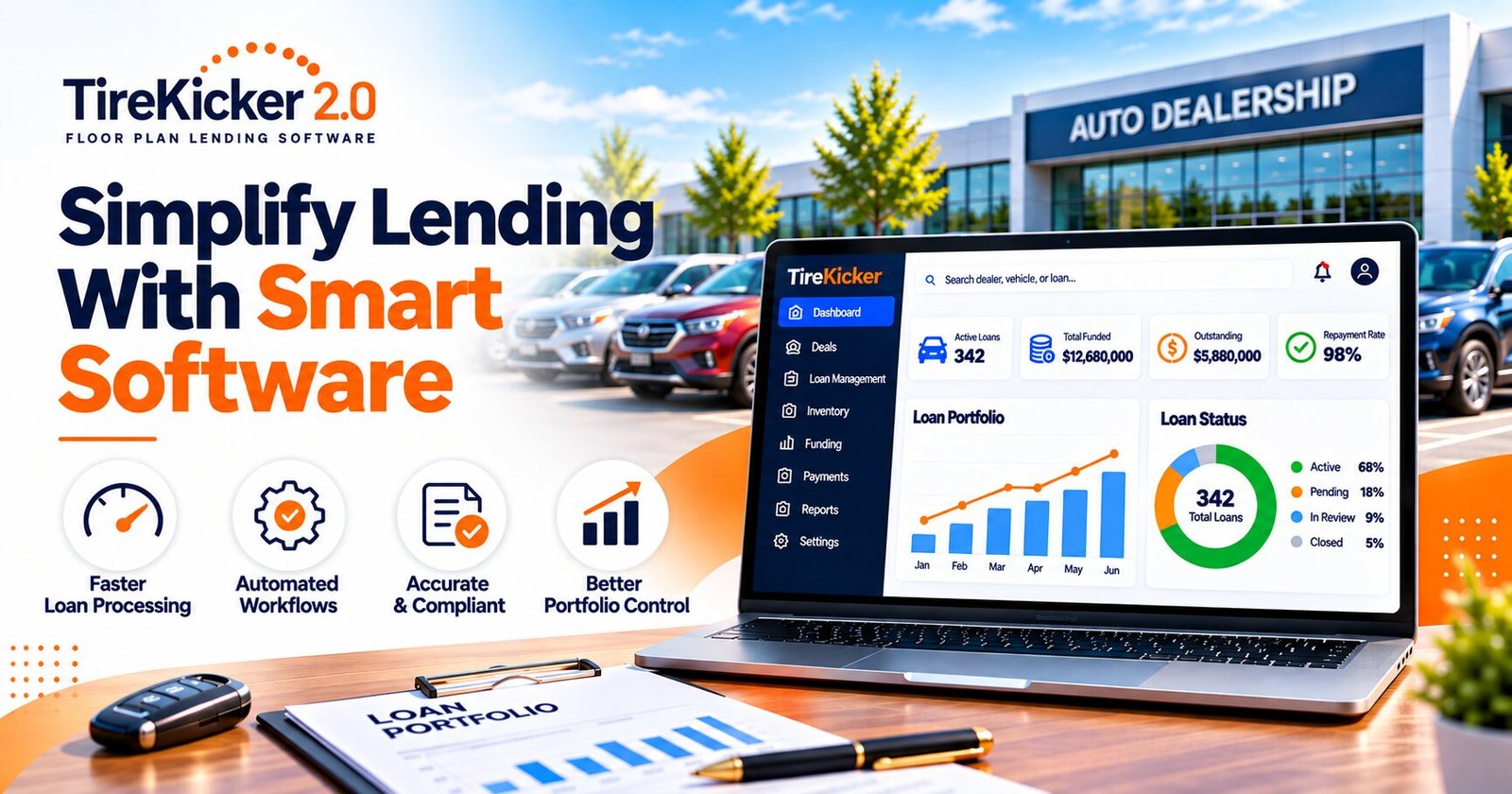
TireKicker 2.0 is a floor plan lending software platform developed specifically for automotive lenders and financial institutions. Built on more than 25 years of industry experience, the platform focuses on the operational requirements associated with managing dealer financing and financed vehicle inventory.
Rather than functioning as a generic loan administration system, TireKicker 2.0 brings important floor plan lending activities together within a centralized platform. This provides lending teams with an organized environment for managing information and coordinating responsibilities across different areas of their operations.
Some of the platform’s capabilities include:
Dealer and Advance Management
TireKicker 2.0 supports dealer account management and advance tracking, helping lenders maintain organized information associated with dealer financing relationships and outstanding advances.
Vehicle Inventory Management
The platform provides vehicle inventory management capabilities that help lenders maintain information about financed vehicles and their associated dealer accounts. This supports the connection between dealer financing activities and the assets involved in floor plan lending.
Billing and Payment Processing
Billing and payment capabilities help lenders organize financial activities associated with dealer accounts. The platform supports processes involving invoices, curtailments, payoffs, fees, and payment records.
Audit and Compliance Management
Audit management capabilities help lenders organize inventory audit activities, maintain audit records, and identify discrepancies that require additional attention. These functions support more structured operational responsibilities.
Title and Collateral Management
TireKicker 2.0 supports title and collateral tracking, helping lenders maintain information about vehicle titles, outstanding documentation, and related collateral records.
Reporting and Analytics
Reporting and analytics capabilities help lending teams review dealer activity, asset information, and other operational records. These capabilities provide management with organized information for internal reviews and business oversight.
By bringing these capabilities together, TireKicker 2.0’s software features support a more connected approach to managing floor plan lending operations. The platform provides an industry-specific foundation for organizing dealer financing activities and maintaining visibility across important business responsibilities.
Conclusion
Efficient automotive lending operations depend on more than maintaining loan records and completing individual transactions. Lenders also need organized workflows, consistent information, effective coordination between employees, and processes that can support changing business requirements.
Auto loan software helps bring these operational elements together within a connected working environment. By supporting structured workflows, improving internal coordination, organizing business information, and providing better operational visibility, software can help lending organizations establish more consistent processes.
For floor plan lenders, choosing a platform designed around dealer financing is particularly important. Their operational requirements involve connected relationships between dealers, advances, vehicle inventory, payments, titles, collateral, and audits.
TireKicker 2.0 addresses these industry-specific requirements through a centralized floor plan lending platform. Its capabilities support the organization of important lending activities and provide automotive lenders with a structured environment for managing their day-to-day operations and supporting business growth.


