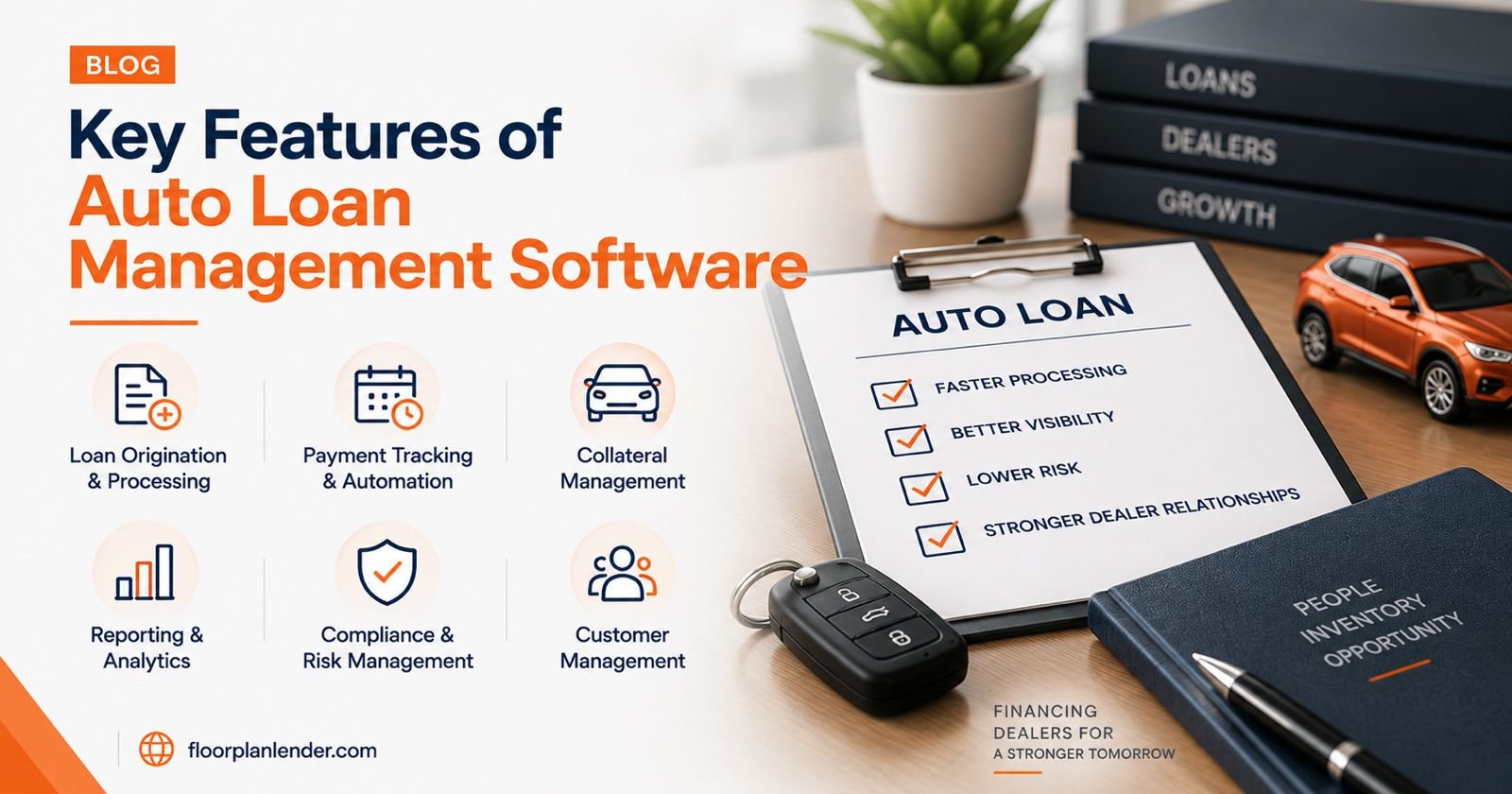
Managing auto loans involves much more than tracking balances and payment dates. For lenders and auto finance companies, the lending process can involve dealer relationships, vehicle inventory, collateral, titles, repayments, audits, compliance, reporting, and communication all at the same time.
As these operations grow, auto loan management software can provide a centralized way to manage these interconnected activities. The right platform should give lenders visibility across their portfolios while providing dealerships with the tools they need to manage advances, inventory, payments, titles, audits, and compliance.
For lenders, banks, finance companies, and auto dealerships evaluating an auto lending software solution such as TireKicker 2.0, here are the key features to look for.
Comprehensive Advance Management
Advance management should be at the center of effective auto finance software. Lenders need to create and manage advances, monitor their status, and follow each account throughout its lifecycle.
A capable system should support active, overdue, and paid-off advances, along with payment schedules and interest-rate management. It should also make it possible to handle early settlements, payoff quotes, adjustments, curtailments, and refinancing when required.
TireKicker 2.0 includes advance management designed to cover the process from creation through closure. Lenders can view advance details, access linked dealer and inventory information, manage adjustments, and export advance summaries.
This type of centralized advance management gives lending teams a clearer view of individual accounts and the overall portfolio.
Dealer Management and Onboarding
Dealer relationships are a fundamental part of auto lending. For this reason, dealer management software should provide more than a basic contact database.
Look for features that support dealer onboarding, profile management, creditworthiness information, compliance tracking, permissions, credit limits, communications, and performance reporting.
TireKicker 2.0 provides lenders with dealer management capabilities that include searching and viewing dealer profiles, adding dealers, reviewing creditworthiness and ratings, monitoring compliance, managing communications, and reviewing dealer performance.
The platform also provides dealer-specific functionality for managing business information, documents, advances, payments, inventory, titles, audits, and compliance.
For lenders working with multiple dealerships, having these records organized in one system can make dealer relationship management more structured.
Vehicle Inventory and Collateral Management
For auto lenders, the financed vehicle is a critical part of the lending relationship. Vehicle inventory management software should therefore provide detailed visibility into financed inventory and collateral.
Important capabilities include searching vehicles by VIN, make, or model; viewing inventory by dealer or advance; tracking vehicle status; identifying missing or sold vehicles; and monitoring audit flags.
TireKicker 2.0 allows lenders to view inventory according to dealer, advance, or status, including available, missing, and sold vehicles. Lenders can search by VIN, make, and model while also monitoring title statuses and audit-related flags.
Dealers also receive tools to view financed vehicles, update statuses, search inventory, and identify flagged issues.
This level of inventory visibility is particularly relevant for lending operations where financed vehicles serve as collateral.
Title Management
Vehicle titles require careful tracking because their status can change as vehicles are financed, sold, and released.
When evaluating auto loan software, look for title-management capabilities that provide visibility into titles that are held, pending, or released. The system should also support title release requests, proof-of-sale documentation, and reporting.
TireKicker 2.0 includes title management for both lenders and dealers. Lenders can manage collateral titles, title release workflows, retention rules, compliance reporting, and disputes. Dealers can view title statuses, submit release requests, provide proof of sale, and access title reports.
When title information is connected with inventory and advance records, lending teams can maintain a more complete view of the collateral associated with their portfolio.
Audit and Compliance Management
Audits are another important consideration when selecting auto lending software. Lenders may need to verify financed inventory, identify discrepancies, document findings, and track resolutions.
A useful system should support on-site and virtual audits, auditor assignments, variance tracking, compliance flags, and audit reporting.
TireKicker 2.0 enables lenders to schedule audits, assign auditors, monitor progress, record discrepancies such as missing vehicles, and generate audit and compliance reports.
The administrative portal also includes configurable variance thresholds, resolution tracking, compliance reporting, and audit monitoring.
For dealers, the platform provides access to scheduled and past audits, discrepancies, document uploads, and compliance and performance tracking.
Repayment and Payment Management
Payment management is a core requirement for any auto loan management software platform. Lenders need to know what has been paid, what is outstanding, and which accounts require attention.
Look for software that provides payment schedules, payment histories, overdue tracking, manual payment entry, billing information, and payment notifications.
TireKicker 2.0 provides repayment tracking that includes on-time, overdue, and delinquent payment visibility, payment details and history, and manual payment entry. Its dealer functionality also includes payment schedules, online payment options such as ACH, payment history, reminders, and late-fee information.
Centralizing payment information can give lenders and dealers a clearer view of repayment activity and account status.
Dashboards, Reporting, and Analytics
A strong auto loan reporting software solution should turn operational data into information lending teams can use.
A lender dashboard should provide visibility into advances issued, outstanding balances, overdue payments, active dealers, collateral inventory, dealer performance, payments, billing, audits, and inventory.
TireKicker 2.0’s lender dashboard is designed around these areas, with graphical trends, recent activity, alerts, and quick actions.
Reporting capabilities are equally important. TireKicker 2.0 supports financial, advance, dealer, and inventory performance reporting, along with real-time visualizations and standard or customized reports that can be exported in PDF or Excel formats.
For organizations with different reporting requirements, customizable reports can be particularly useful.
Role-Based Access and User Management
Not every user should have access to the same information or functions. Lenders, dealers, administrators, auditors, and other users may have different responsibilities.
Loan management software should therefore provide role-based permissions and user management.
TireKicker 2.0 includes administrative tools for creating, editing, deactivating, and deleting users, assigning roles and permissions, maintaining activity logs, supporting password resets, and using two-factor authentication. Administrators can also create custom roles with read-only or full-access rights.
This gives organizations greater control over who can access and modify different areas of the platform.
Notifications and Communication
Timely communication can be important for payment deadlines, audits, compliance issues, and other lending activities.
When evaluating auto finance software, look for configurable notifications rather than requiring teams to monitor every account manually.
TireKicker 2.0 supports automated payment and audit alerts, announcements, and communication through email, SMS, and dashboard notifications. The platform also provides communication tools for lender-dealer inquiries, document sharing, and notifications.
These capabilities help keep relevant users informed as account activity changes.
Security and Audit Trails
Because loan management software handles financial, business, and operational information, security controls should be part of the evaluation process.
Important features include access controls, activity logging, session management, security monitoring, authentication controls, backups, and recovery processes.
TireKicker 2.0 includes role-based access controls, security logs, session management and timeouts, suspicious-activity alerts, security audits, two-factor authentication, IP whitelisting, backups, recovery processes, and vulnerability-testing capabilities.
The platform also maintains audit trails covering user logins, data changes, payments, and other important system activities.
Customization and Scalability
Every lending organization operates differently. Some may have different advance policies, asset categories, workflows, audit requirements, or geographic operating models.
Auto loan management software should therefore be flexible enough to accommodate changing requirements.
TireKicker 2.0 supports customizable templates for asset categories, including vehicles and other collateral types, along with configurable fields and administrative controls. The platform also includes zone management for geographic or collateral zones.
Its administrative capabilities extend to workflow customization, new asset types, advance-process configuration, resource monitoring, and performance optimization.
This flexibility can help organizations adapt the platform as their lending processes and requirements evolve.
Why These Features Matter for Auto Lenders and Dealerships
The best auto lending software should connect the different parts of lending operations rather than treating each activity as a separate process.
Advance management connects with dealer relationships. Dealer accounts connect with vehicle inventory. Inventory connects with collateral and titles. Payments connect with advances and billing. Audits connect with inventory and compliance. Reporting brings information from these areas together for portfolio visibility.
TireKicker 2.0 is designed around this connected approach, with dedicated functionality for lenders, dealers, and administrators. Its lender and dealer dashboards provide role-specific information, while administrative controls provide configuration, security, reporting, billing, and system-management capabilities.
Choosing the Right Auto Loan Management Software
When comparing auto loan management software, lenders should look beyond a simple loan-tracking feature list. The right solution should support the broader operational picture: advances, dealers, vehicles, collateral, titles, payments, audits, reporting, communication, security, and administration.
It is also worth considering whether the software can adapt as lending requirements change. Features such as customizable templates, configurable workflows, reporting options, role-based permissions, and scalable system architecture can be important when an organization grows or changes its processes.
For lenders and auto finance companies looking for a centralized platform, TireKicker 2.0 brings these capabilities together in a system designed around dealer financing and collateral management.
Conclusion
Auto loan management software should do more than record loan information. It should provide lenders with visibility into advances, dealer relationships, financed vehicles, titles, payments, audits, compliance, and portfolio performance.
When evaluating a solution, prioritize features that connect these areas while providing appropriate access, reporting, communication, security, and customization.
With its lender, dealer, and administrative functionality, TireKicker 2.0 provides a comprehensive set of tools for managing the operational side of auto lending—from advance creation and inventory tracking to repayments, audits, titles, reporting, and ongoing portfolio administration.


